Recently in Recordings
The Sixteen continues its exploration of Henry Purcell’s Welcome Songs for Charles II. As with Robert King’s pioneering Purcell series begun over thirty years ago for Hyperion, Harry Christophers is recording two Welcome Songs per disc.
In February this year, Albanian soprano Ermonela Jaho made a highly lauded debut recital at Wigmore Hall - a concert which both celebrated Opera Rara’s 50th anniversary and honoured the career of the Italian soprano Rosina Storchio (1872-1945), the star of verismo who created the title roles in Leoncavallo’s La bohème and Zazà, Mascagni’s Lodoletta and Puccini’s Madama Butterfly.
Collapsology. Or, perhaps we should use the French word ‘Collapsologie’ because this is a transdisciplinary idea pretty much advocated by a series of French theorists - and apparently, mostly French theorists. It in essence focuses on the imminent collapse of modern society and all its layers - a series of escalating crises on a global scale: environmental, economic, geopolitical, governmental; the list is extensive.
Amongst an avalanche of new Mahler recordings appearing at the moment (Das Lied von der Erde seems to be the most favoured, with three) this 1991 Mahler Second from the 2nd Kassel MahlerFest is one of the more interesting releases.
If there is one myth, it seems believed by some people today, that probably needs shattering it is that post-war recordings or performances of Wagner operas were always of exceptional quality. This 1949 Hamburg Tristan und Isolde is one of those recordings - though quite who is to blame for its many problems takes quite some unearthing.
The voices of six women composers are celebrated by baritone Jeremy Huw Williams and soprano Yunah Lee on this characteristically ambitious and valuable release by Lontano Records Ltd (Lorelt).
As Paul Spicer, conductor of the Royal Birmingham Conservatoire Chamber Choir, observes, the worship of the Blessed Virgin Mary is as ‘old as Christianity itself’, and programmes devoted to settings of texts which venerate the Virgin Mary are commonplace.
Ethel Smyth’s last large-scale work, written in 1930 by the then 72-year-old composer who was increasingly afflicted and depressed by her worsening deafness, was The Prison – a ‘symphony’ for soprano and bass-baritone soloists, chorus and orchestra.
‘Hamilton Harty is Irish to the core, but he is not a musical nationalist.’
‘After silence, that which comes closest to expressing the inexpressible is music.’ Aldous Huxley’s words have inspired VOCES8’s new disc, After Silence, a ‘double album in four chapters’ which marks the ensemble’s 15th anniversary.
A song-cycle is a narrative, a journey, not necessarily literal or linear, but one which carries performer and listener through time and across an emotional terrain. Through complement and contrast, poetry and music crystallise diverse sentiments and somehow cohere variability into an aesthetic unity.
One of the nicest things about being lucky enough to enjoy opera, music and theatre, week in week out, in London’s fringe theatres, music conservatoires, and international concert halls and opera houses, is the opportunity to encounter striking performances by young talented musicians and then watch with pleasure as they fulfil those sparks of promise.
“It’s forbidden, and where’s the art in that?”
Dublin-born John F. Larchet (1884-1967) might well be described as the father of post-Independence Irish music, given the immense influenced that he had upon Irish musical life during the first half of the 20th century - as a composer, musician, administrator and teacher.
The English Civil War is raging. The daughter of a Puritan aristocrat has fallen in love with the son of a Royalist supporter of the House of Stuart. Will love triumph over political expediency and religious dogma?
Beethoven Symphony no 9 (the Choral Symphony) in D minor, Op. 125, and the Choral Fantasy in C minor, Op. 80 with soloist Kristian Bezuidenhout, Pablo Heras-Casado conducting the Freiburger Barockorchester, new from Harmonia Mundi.
A Louise Brooks look-a-like, in bobbed black wig and floor-sweeping leather trench-coat, cheeks purple-rouged and eyes shadowed in black, Barbara Hannigan issues taut gestures which elicit fire-cracker punch from the Mahler Chamber Orchestra.
‘Signor Piatti in a fantasia on themes from Beatrice di Tenda had also his triumph. Difficulties, declared to be insuperable, were vanquished by him with consummate skill and precision. He certainly is amazing, his tone magnificent, and his style excellent. His resources appear to be inexhaustible; and altogether for variety, it is the greatest specimen of violoncello playing that has been heard in this country.’
Baritone Roderick Williams seems to have been a pretty constant ‘companion’, on my laptop screen and through my stereo speakers, during the past few ‘lock-down’ months.
Melodramas can be a difficult genre for composers. Before Richard Strauss’s Enoch Arden the concept of the melodrama was its compact size – Weber’s Wolf’s Glen scene in Der Freischütz, Georg Benda’s Ariadne auf Naxos and Medea or even Leonore’s grave scene in Beethoven’s Fidelio.
Recordings
20 May 2010
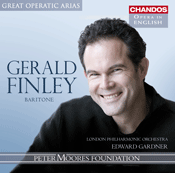
Great Operatic Arias with Gerald Finley
Listeners who have appreciated Gerald Finley’s stylish and moving
singing of baritone roles in operas by Mozart and other composers will be
pleased with the recent CD release of Great Operatic Arias in English.
In addition to Don Giovanni’s famous duet with Zerlina, several roles
created by Finley on stage are featured in excerpt on this recording. Arias
from Doctor Atomic by John Adams and The Silver Tassie by
Mark-Anthony Turnage are performed here by Finley with great commitment,
reminiscent indeed of his original live performances. One also has the
opportunity to hear Finley in less accustomed repertoire by Weber, Donizetti,
Puccini, and Wagner. Several of the excerpts performed are operatic ensembles
or duets in which Finley is well supported by soloist colleagues and the
Geoffrey Mitchell Choir. The London Philharmonic Orchestra provides
accompaniment under the skillful direction of Edward Gardner.
In the earliest pieces composed and featured in this collection, the duet
from Mozart’s Don Giovanni and an aria from Weber’s
Euryanthe, Finley shows his characteristic ability to inhabit a role,
so that he sings and acts with his voice as one. In both excerpts Finley
communicates urgency and emotions that suggest a complexity of character.
Lysiart’s aria from Euryanthe begins with a declamatory style at
which Finley excels, his diction matching the soul-searching questions of the
character. As the piece increases in melodic interest Finley’s approach
gains intensity with full decorative force layered onto phrases such as
“death and vengeance.” At the close of this scene, the longest in
the collection, one has gazed via Finley’s interpretive singing into the
conflicting sides of Lysiart’s character, the forces of destruction
ultimately winning the upper hand. The duet from Don Giovanni, “Là ci
darem la mano,” shared here with Lucy Crowe and performed as “There
will my arms enfold you,” illustrates well the rich legato, which is a
hallmark of Finley’s singing in such roles where it is appropriate. One
can sense the voice performing the act of a seductive embrace as he allows the
lines to flow with baritonal resonance.
In yet other styles Finley makes an equally strong impression, such as
Robert’s aria “My only beloved Matilde I claim” from
Tchaikovsky’s Iolanta. In this piece, requiring a strong lyrical
approach punctuated by dramatic accents Finley builds gradually in his
contemplation of the mutual passion with his beloved. During the initial
recitation the singer emphasizes Matilde’s name and its effect on Robert;
here Finley intones the word “overpower” in order to give musical
expression to his ardor. As often, it is refreshing to listen to Finley sing
such words or phrases forte and in upper registers without giving the
least sign of strain. Further accents on “her face” and “her
eyes” lead to the acceptance of Matilde’s physical
“perfection” — and its communication of emotion — with
a carefully modulated coloration of the voice. In the repeat of the
text’s first half the dramatic result is underlined by Finley’s
sustained pitches on “like flame or like wine,” with which the aria
effectively concludes.
In those contemporary operatic selections here included, which were
originally composed to English texts, Finley’s performances set a
standard for the repertoire. The aria sung by Harry from Turnage’s opera
The Silver Tassie is performed just before the lead character must
return to the trenches of World War I after having spent leave-time in his
native Dublin. After a dissonant orchestral beginning each verse accompanied by
a simple, repeating line serves as an understated reflection on service and the
toll it takes on individual feelings or private loyalties. Finley approaches
the overtly song-like nature of the piece as an exercise in variation. He sings
the first four verses softly, nearly piano, in a melancholy yet
determined resolve to fulfill his military duty while not forgetting the calls
of the homeland. Although each line follows essentially the same pattern, the
vocal decorations are varied subtly just before or at the point of the
end-rhymes. The omnipresent mood of war is suggested by an orchestral intrusion
starting at the mid-point of the aria and returning intermittently until the
end. Finley responds to these reminders of conflict by inflecting his
statements with controlled yet rising pitches, which essentially yield a
disciplined variation of the opening lines. The old is confronted by the new,
as inevitable change caused by the War is registered in the spirit of Harry and
his generation. The second piece from this group is the aria “Batter my
heart” from John Adams’s opera Doctor Atomic.
Finley’s performance as Oppenheimer in this work has been celebrated in
various productions throughout the operatic world, e.g. at Lyric Opera of
Chicago. Here the justly chosen aria, based on a poem by John Donne, showcases
both the music and Finley’s association with it. The dilemma of
Oppenheimer in his work on the horrific weapon causes him to turn to God and to
appeal for renewal in his feelings for humanity. Finley negotiates convincingly
the undulating intonations in the first four verses and their repetition, as
exemplified in the lyrics “three person’d God” and
“break, blow, burn, and make me new.” These verses are surrounded
by intricate orchestral colorings functioning almost as an interlude of
contemplation for the main character. As Finley’s voice rises with
intense expression on individual words (“never shall be free,”
“except you ravish me”), the listener senses the inner
struggles which continue beyond the moment of appeal.
As an example of Finley’s versatility in other repertoire we may look
to Antonio’s scena from Linda di Chamounix —
composed as an aria and duet sung together with the figure of Maddalena —
during which the father’s fears for Linda are expressed. In the
introductory aria Finley demonstrates a mastery of bel canto singing in his
ideal combination of broad legato and carefully placed decorative
melismas on key words such as “altar” and “father.” The
accompanying duet shared with Anne Marie Gibbons illustrates Finley’s
skill at participating in a vocal line with an emphasis on expressive ensemble
singing. The remaining selections in this cd are well chosen and give
indication of Finley’s potential future projects for both operatic stage
and recording. Several of the translations used in this cd were recently
commissioned or produced at the time of the recording.
Salvatore Calomino