Subscribe to
Opera Today

Receive articles and news via RSS feeds or email subscription.


twitter_logo[1].gif


9780521746472.png

Recently in Performances

The Importance of Being Earnest, Covent Garden

The Importance of Being Earnest , Gerald Barry’s fifth opera, was commissioned by the Los Angeles Philharmonic Orchestra and the Barbican, and was first performed in concert, Thomas Adès conducting the London premiere.

Death in Venice by ENO

‘Beauty is the one form of spirituality that we experience through the senses.’ In Thomas Mann’s, Death in Venice, Plato’s axiom stirs the hopes of the aging, intellectually stale poet, Gustav von Aschenbach, that he may rekindle his creativity.

Madama Butterfly, Opera Holland Park

There is a sense in which it all began in London, Puccini having been seized in 1900 with the idea of an opera on this subject after watching David Belasco’s play here.

An Evening of Zarzuela and Latin American Music at Los Angeles Opera

The tenor that the audience most wanted to hear, Plácido Domingo, opened the vocal program with “Junto al puente de la peña” (Next to the rock bridge) from La Canción del Olvido (The song of Oblivion) by José Serrano. He sounded rested and his voice soared majestically over the orchestra.

Così fan tutte in San Francisco

Tucked away somewhere in the San Francisco Opera warehouse was an old John Cox production of Così fan tutte from Monte Carlo. Well, not that old by current standards at San Francisco Opera.

Rossini Maometto Secondo Garsington Opera at Wormsley

Rossini's Maometto Secondo is a major coup for Garsington Opera at Wormsley, confirming its status as the leading specialist Rossini house in Britain. Maometto Secondo is a masterpiece, yet rarely performed because it's formidably difficult to sing. It's a saga with some of the most intense music Rossini ever wrote, expressing a drama so powerful that one can understand why early audiences needed "happy endings" to water down its impact

Peter Grimes in Concert

I suppose it was inevitable that, in this Britten Centenary year, the 66th Aldeburgh Festival would open with Peter Grimes.

Die Entführung aus dem Serail, Garsington Opera at Wormsley

Die Entführung aus dem Serail at Garsington Opera at Wormsley isn’t Mozart as you’d expect but it’s true to the spirit of Mozart who loved witty, madcap japes.

Le nozze di Figaro, Glyndebourne

What a pity! On a glorious — well, by recent English standards — summer’s day, there can be few more beautiful English countryside settings than Glyndebourne, with the added bonus, as alas much of the audience appears to understand it, of an opera house attached.

Queens, Heroines and Ladykillers

Described by one critic as “cosmically gifted”, during her tragically short career, American mezzo-soprano Lorraine Hunt Lieberson amazed and delighted audiences with the spellbinding beauty of her singing and the astonishing honesty of her performances.

Alzira by Chelsea Opera Group

“I wrote it almost without noticing.” So Verdi declared when reminded of his eighth — and perhaps least frequently performed, opera, Alzira. One might say that, since he composed the work, no-one else has much noticed either.

Les Contes d’Hoffmann in San Francisco

Just when you thought the protagonist was Hoffmann! Who, rather what stole the show?

La Tosca in Los Angeles

When is verismo verily veristic? Or what is a virginal girl dressed in communion white doing in the two murderous acts of the Los Angeles Opera’s current production of Tosca? And why does she sing the shepherd's song?

Lohengrin, Welsh National Opera

Wagner’s Lohengrin is not an unfamiliar visitor to the UK thanks, in the main, to Elijah Moshinsky’s perennial production at Covent Garden.

Philip Glass: The Perfect American

Philip Glass's The Perfect American at the ENO in London is a visual treat, but the libretto is mind-numbingly anodyne.

Jonathan Dove’s Mansfield Park

Jonathan Dove's Mansfield Park, with libretto by his regular collaborator Alasdair Middleton, has the remarkable distinction of being the first completed operatic adaptation of any Jane Austen novel to be staged.

Wagner 200th Anniversary Concert

London’s two principal opera companies have offered a baffling near-silence as their response to Wagner’s two-hundredth anniversary.

Toronto’s Triple Success

If a recent trio of musically superlative performances at Canadian Opera Company is indicative of their norm, the casting director should get a hefty bonus.

Alessandro Scarlatti’s Il Trionfo dell’Onore

Just when you imagine you’ve got the operatic time-line fixed in your mind in a clean sweep of what goes where and when and how, you hear another work from another forgotten corner of the repertory that upends one’s conclusions.

Handel’s Rodrigo by Operamission

Nothing inspires fable quite like defeat. The great riddle of Spanish history is how the Christian Visigoths managed to lose the Iberian peninsula to the Moors in one small battle in 711 and took eight hundred years to get it back.

OPERA TODAY ARCHIVES »

Performances

Aleksandra Kurzak as Rosina [Photo by Mike Hoban courtesy of The Royal Opera House]
24 Jan 2011

Il barbiere di Siviglia, Covent Garden

In my July 2009 review of the first revival of Moshe Leiser’s and Patrice Caurier’s 2005 production of Il barbiere di Siviglia I commented that the directors, aided by conductor, Antonio Pappano, had reinvigorated this operatic ‘old friend’, injecting freshness and spontaneity into familiar material.

Gioachino Rossini: Il barbiere di Siviglia

Rosina: Aleksandra Kurzak; Count Almaviva: John Osborn; Figaro: Levente Molnár; Doctor Bartolo: Bruno Praticò; Don Basilio: Ildar Abdrazakov; Berta: Jennifer Rhys-Davies; Fiorello: Daniel Grice. Directors: Moshe Leiser, Patrice Caurier. Conductor: Rory Macdonald. Set Designer: Christian Fenouillat. Costume designs: Agostino Cavalca. Lighting: Christophe Forey. Royal Opera House, Covent Garden, Tuesday 18th January 2011.

Above: Aleksandra Kurzak as Rosina

All photos by Mike Hoban courtesy of The Royal Opera House


Eighteen months later, under the revival director, Justin Way, the singing is still of a consistently high quality, at times reaching giddy heights, the costumes are just as gaudily dazzling, and the setting zany, even giddily anarchic. But, like a magnum of vintage champagne, its glossy labels promising much but the bottle left uncorked just a bit too long, this first night performance was distinctly lacking in fizz, the whole experience dramatically rather flat. When one of the best of all buffa operas struggles to raise a laugh in its opening hour, you know that something is not quite right.

There were certainly no complaints about the assembled cast of principals. American tenor, John Osborn, was musically and dramatically at ease in the role of Count Almaviva, delivering his opening aria, ‘Ecco ridente’, nonchalantly balanced in the twilit branches beneath the window of his beloved’s boudoir. His voice is quite light, and lacks a truly resonant gleam, but Osborn’s tone is sweet and relaxed, his phrases musically shaped and his projection even. His gentle lyricism deftly conveyed the Count’s heartfelt ardour and the anguish of unrequited love; and he displayed a similarly tender tenore di grazia in his Act 2 ‘Cessa di piu resistere’. As the evening progressed Osborn settled comfortably into the comic capers, enjoying the obsequious fawning of music-maestro, Alonso, and making a convincing and likeable drunken rabble-rouser.

As the self-important factotum, Transylvanian baritone, Levente Molnár, exhibited a powerful vocal instrument and bracing stage presence in the role of Figaro. Emerging from among the ranks of a surprised stall’s audience, springing athletically onto the stage, he brought an extrovert swagger to the role of barber and man-about-town. The energy of his entry was sustained throughout, but I thought there was a bit too much bluster and bluff, and a tendency to shout, particularly at the start. However, he certainly had the measure of the tongue-twisting text in ‘Largo al factotum’.

Bruno Praticò, as Doctor Bartolo, delivered his patter in similarly impressive and slick style in his Act 1 aria, ‘A un dottor delta mia sorte’, and demonstrated a sure sense of comic timing. But, he was ‘out-done’ in the comedy stakes by the extraordinary performance of Russian bass, Ildar Abdrazakov, whose powerful boom was almost over-shadowed by his astonishing physical exploits, which suggested that this Basilio was not only warped by malice and envy but truly demented!

Among this strong cast, the star of the show was, however, Polish soprano, Aleksandra Kurzak. Only the previous day, Kurzak had signed an exclusive recording contract with Decca, and the studio must be delighted and excited to have ‘hooked’ a singer who is certainly a luminary in the making. Kurzak combines technical assurance with an innate sense of dramatic pacing. The pyrotechnics scarcely caused her to bat an eyelid: she made it sound entirely natural to leap between registers and ornament extravagantly — seldom can coloratura have seemed so ‘normal’ a means of communication. Her effortless delivery, swooning sweetness turning to steely feistiness in a flash, was utterly bewitching. And she knows how to play the audience, her petulant dart-throwing in the middle of a sparkling, nimble ‘Una voce poco fa’, prompted the first real laugh, as Rosina’s ‘goodness’ — ‘I’m obedient, gentle, and loving’ — was ironically belied by a sudden flash of adolescent rage.
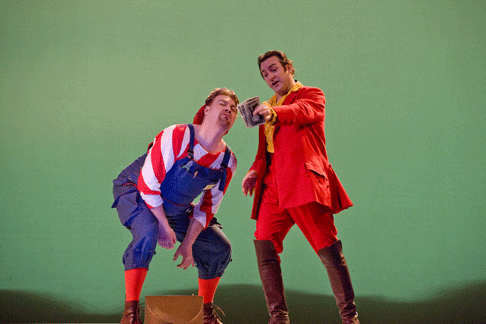
BARBIERE-10013_0019-MOLNAR&.gifLevente Molnár as Figaro and John Osborn as Count Almaviva

The designs are inventive and Christian Fenouillat’s minimalist sets eye-catching: a crescent moon against a purple sky gleamingly illuminates a silhouetted tree beneath Rosina’s balcony; stripy pastel clashes and playful postmodern dots are eye-watering, and emphasise the surreal air of anarchy. This visual playfulness is aptly complemented by the costumes of Agostino Cavalca.

Rory Macdonald conducted the ROH orchestra in a precise but unexhilarating reading of the score, accurate and crisply articulated but lacking frisson or a sense of risk. The greatest sense of danger came in the Act 1 finale, when the wildly tilting stage threatened to tip and toss the chorus of plastic-gowned gendarmes — who struggled gamely to stay upright but gave little impression of knowing what they would do if they did regain the perpendicular — into a muddled mound. There was a sense of impending doom as stage and pit also went adrift. Plenty of chaos, but not much comedy.
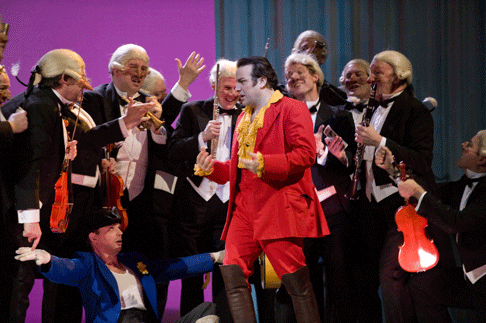
BARBIERE-10013_0005-GRICE&O.gifDaniel Grice as Fiorello, John Osborn as Count Almaviva and The Royal Opera Chorus

During the first revival, American soprano, Joyce DiDonato, did indeed take a tumble, breaking her leg in the process, and was forced to deliver the remainder of the run wheel-chair bound. Perhaps it was the added sense of unpredictably that this lent to the proceedings that kept me on the edge of my seat last time around. The dress rehearsal for this revival did in fact suffer its own near-disaster, when the stage set and machinery refused to co-operate and the cast had to perform in front of the safety curtain, the chorus singing from the stalls. It seems that this revival needs a touch of the unexpected to add a little spontaneity and surprise.

Claire Seymour

Click here for Claire’s review of the first revival.

Send to a friend

Send a link to this article to a friend with an optional message.

Friend's Email Address: (required)

Your Email Address: (required)

Message (optional):