![Christopher Purves as Mephistopheles [Photo by Tristram Kenton courtesy of English National Opera]](http://www.operatoday.com/Damnation-Of-Faust_Christop.gif)
09 May 2011
The Damnation of Faust, ENO
Terry Gilliam was one of the forces behind Monty Python, the popular British TV comedy of the 1970’s. His fans will flock in droves to his version of Berlioz’s The Damnation of Faust at the ENO, London.
English Touring Opera are delighted to announce a season of lyric monodramas to tour nationally from October to December. The season features music for solo singer and piano by Argento, Britten, Tippett and Shostakovich with a bold and inventive approach to making opera during social distancing.
This tenth of ten Live from London concerts was in fact a recorded live performance from California. It was no less enjoyable for that, and it was also uplifting to learn that this wasn’t in fact the ‘last’ LfL event that we will be able to enjoy, courtesy of VOCES8 and their fellow vocal ensembles (more below …).
Ever since Wigmore Hall announced their superb series of autumn concerts, all streamed live and available free of charge, I’d been looking forward to this song recital by Ian Bostridge and Imogen Cooper.
The Sixteen continues its exploration of Henry Purcell’s Welcome Songs for Charles II. As with Robert King’s pioneering Purcell series begun over thirty years ago for Hyperion, Harry Christophers is recording two Welcome Songs per disc.
Although Stile Antico’s programme article for their Live from London recital introduced their selection from the many treasures of the English Renaissance in the context of the theological debates and upheavals of the Tudor and Elizabethan years, their performance was more evocative of private chamber music than of public liturgy.
In February this year, Albanian soprano Ermonela Jaho made a highly lauded debut recital at Wigmore Hall - a concert which both celebrated Opera Rara’s 50th anniversary and honoured the career of the Italian soprano Rosina Storchio (1872-1945), the star of verismo who created the title roles in Leoncavallo’s La bohème and Zazà, Mascagni’s Lodoletta and Puccini’s Madama Butterfly.
Evidently, face masks don’t stifle appreciative “Bravo!”s. And, reducing audience numbers doesn’t lower the volume of such acclamations. For, the audience at Wigmore Hall gave soprano Elizabeth Llewellyn and pianist Simon Lepper a greatly deserved warm reception and hearty response following this lunchtime recital of late-Romantic song.
Collapsology. Or, perhaps we should use the French word ‘Collapsologie’ because this is a transdisciplinary idea pretty much advocated by a series of French theorists - and apparently, mostly French theorists. It in essence focuses on the imminent collapse of modern society and all its layers - a series of escalating crises on a global scale: environmental, economic, geopolitical, governmental; the list is extensive.
For this week’s Live from London vocal recital we moved from the home of VOCES8, St Anne and St Agnes in the City of London, to Kings Place, where The Sixteen - who have been associate artists at the venue for some time - presented a programme of music and words bound together by the theme of ‘reflection’.
'Such is your divine Disposation that both you excellently understand, and royally entertaine the Exercise of Musicke.’
Amongst an avalanche of new Mahler recordings appearing at the moment (Das Lied von der Erde seems to be the most favoured, with three) this 1991 Mahler Second from the 2nd Kassel MahlerFest is one of the more interesting releases.
‘And there was war in heaven: Michael and his angels fought against the dragon; and the dragon fought and his angels, And prevailed not; neither was their place found any more in heaven … that old serpent … Satan, which deceiveth the whole world: he was cast out into the earth, and his angels were cast out with him.’
If there is one myth, it seems believed by some people today, that probably needs shattering it is that post-war recordings or performances of Wagner operas were always of exceptional quality. This 1949 Hamburg Tristan und Isolde is one of those recordings - though quite who is to blame for its many problems takes quite some unearthing.
There was never any doubt that the fifth of the twelve Met Stars Live in Concert broadcasts was going to be a palpably intense and vivid event, as well as a musically stunning and theatrically enervating experience.
‘Love’ was the theme for this Live from London performance by Apollo5. Given the complexity and diversity of that human emotion, and Apollo5’s reputation for versatility and diverse repertoire, ranging from Renaissance choral music to jazz, from contemporary classical works to popular song, it was no surprise that their programme spanned 500 years and several musical styles.
The Academy of St Martin in the Fields have titled their autumn series of eight concerts - which are taking place at 5pm and 7.30pm on two Saturdays each month at their home venue in Trafalgar Square, and being filmed for streaming the following Thursday - ‘re:connect’.
The London Symphony Orchestra opened their Autumn 2020 season with a homage to Oliver Knussen, who died at the age of 66 in July 2018. The programme traced a national musical lineage through the twentieth century, from Britten to Knussen, on to Mark-Anthony Turnage, and entwining the LSO and Rattle too.
With the Live from London digital vocal festival entering the second half of the series, the festival’s host, VOCES8, returned to their home at St Annes and St Agnes in the City of London to present a sequence of ‘Choral Dances’ - vocal music inspired by dance, embracing diverse genres from the Renaissance madrigal to swing jazz.
Just a few unison string wriggles from the opening of Mozart’s overture to Le nozze di Figaro are enough to make any opera-lover perch on the edge of their seat, in excited anticipation of the drama in music to come, so there could be no other curtain-raiser for this Gala Concert at the Royal Opera House, the latest instalment from ‘their House’ to ‘our houses’.
"Before the ending of the day, creator of all things, we pray that, with your accustomed mercy, you may watch over us."
Terry Gilliam was one of the forces behind Monty Python, the popular British TV comedy of the 1970’s. His fans will flock in droves to his version of Berlioz’s The Damnation of Faust at the ENO, London.
This production is great theatre, but it’s best approached as a Monty Python skit on the theme of Faust, with incidental soundtrack by Berlioz.
Gilliam’s take on Faust stems from it being a classic of German literature, overlooking the inconvenient fact that Berlioz was French and that Christopher Marlowe, who was English, wrote an important play on the theme centuries before Goethe was even born. The Faust legend has universal resonance, which is why it’s an icon. But Gilliam narrows the focus down to Germany and to the Third Reich. In principle, there’s no reason why it shouldn’t be updated in this way, but it would take a director of genuine vision and insight to develop the concept properly. Gilliam, however, isn’t bothered with veracity as long as he can tell a good story. The problem is that the Nazis and the Holocaust should be much more than props in a feelgood musical.
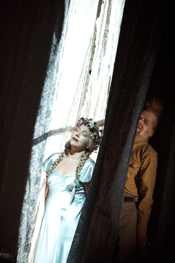 Christine Rice as Marguerite and Peter Hoare as Faust
Gilliam’s The Damnation of Faust reveals itself in a series of tableaux, each of them recognizable images from German art. Beautiful reconstruction of a Romantic painting, a reference to a famous cartoon of the First World War, vignettes from Georg Grosz, and a montage from the films of Leni Reifenstahl. They enfold like pictures in a short illustrated guide to Germany, compiled for illiterates. If we can avoid things like the Holocaust ever happening again, we need to understand the real complexities that brought them about. Comic book cleverness ultimately demeans knowledge, for it substitutes cliché for real thought. Totalitarianism thrives on lazy minds.
Faust (Peter Hoare) sports an upright shock of orange hair. Is this a reference to Peter Sellars? Apart from vague references to books on shelves, there’s precious little of Faust as scientist or idealist in this production. Faust becomes a SA brownshirt, the type whose resentment of intellectuals drove them to burn books. Marguerite (Christine Rice) becomes orthodox Jewish, undressing and swapping wigs while standing before a brightly lit menorah on the Sabbath eve. It’s no surprise that Faust ends up crucified on a swastika cross. Such images have shock value, but unless they’re integrated into an overall vision, they became little more than cheap entertainment.
Perhaps Gilliam is a comedian and is having a joke. But the indications are that he’s taking it all too portentously. “My struggle” says Mephistopheles (Christopher Purves) “Mein Kampf”. The audience obediently titters. Marguerite is shown as Brünnhilde on a rock, surrounded by flames. Faust does a comic impression of Siegfried. While connections between Faust and the Ring do exist, in this production they’re happened upon by accident, no more thought through than some sensationalist yellow press scandal. It’s enough here that Hitler liked Wagner, ergo Wagner was Third Reich.
While Gilliam wasn’t involved in Fawlty Towers, the spin off TV series that followed Monty Python, he falls back on the same mindless xenophobia that infects a large part of the population. The central character in the TV show was obsessed by Germans and the war, unable to think of people as people, only as caricatures. It was too persistent to be satire, and reinforced stereotypes by making them seem like harmless fun. The audience reaction to Gilliam’s gimmicks showed that perhaps Britain hasn’t matured in 30 years.
Significantly, Berlioz’s The Damnation of Faust isn’t an opera but a hybrid from which voices emerge from an orchestral fantasy. This doesn’t preclude staging, and indeed the long passages without text allow greater freedom of interpretation than might normally be the case. But fundamentally, there’s no point in any staging at all if it disregards the original. Berlioz’s orchestral writing is so vividly dynamic that it “is” the drama, the vocal parts devoted to vignettes like “King of Thule” song and “The Flea”. The visuals in this production were so hyperactive that at times, the cast had to slow themselves down not to lose synch with the music.
In a recent interview Gilliam is qouted as saying “Berlioz was crackers, he suffered like I do”. Wagner comes off even worse. Gilliam would cut out the recitatives in the Ring. Yet with metaphysics and subtle complexities expunged, neither Berlioz nor Wagner would be what they are. Just as there’s no real engagement with German history in this production, there’s no real engagement with the music.
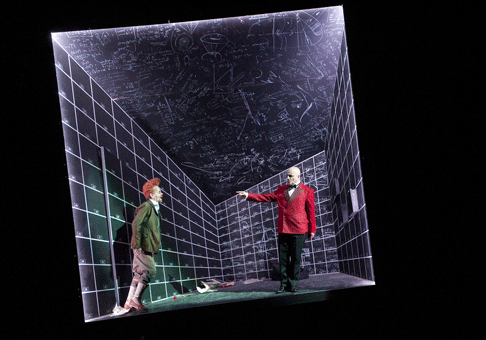 Peter Hoare as Faust and Christopher Purves as Mephistopheles
Superb singing from Christine Rice, way above the level of the rest of the cast. There were momentary lapses elsewhere, the tessitura being to high for Hoare, and the legato unbalanced by clumsy translation. No jokes in the English text this time, for they’d compete with what was happening on stage. Purves and Nicholas Folwell (Brander) were reliable, both parts depending on acting skills as much as on singing. Because the orchestral parts were so critical to Berlioz, it was a balm that Edward Gardner conducted the ENO orchestra well.
The irony of Gilliam’s Damnation of Faust is that audiences who might otherwise howl with rage at more original, challenging work will applaud Gilliam’s indifference to the original. Self referential gags are peppered throughout the production so the audience don’t forget they’ve come for Monty Python, not Goethe or Faust. This is an example of the much maligned but usually misunderstood “Director opera” with a vengeance, but audiences take it because the director happens to be someone popular (and not German). Thus it won’t be damned but lauded.
In Mel Brooks’s 1968 classic, The Producers, two con men cook up the worst possible musical so it will fail and they can run off with investors’ money. The show within the movie is Springtime for Hitler, complete with high stepping SS men. Against all reason, the audience loves it and the show becomes a hit. The Producers was a satire on the gullbility of the public. As long as there’s a song and a dance, people will follow anything.
For more details, please see the ENO website HERE.
For a full download of a performance of Berlioz The Damnation of Faust, with Nicolai Gedda and Marilyn Horne (1968) please see HERE.
Anne Ozorio