06 Sep 2011
Macbeth from Paris and Parma
Superstitions surround theatrical productions of Shakespeare’s Scottish tragedy.
The Sixteen continues its exploration of Henry Purcell’s Welcome Songs for Charles II. As with Robert King’s pioneering Purcell series begun over thirty years ago for Hyperion, Harry Christophers is recording two Welcome Songs per disc.
In February this year, Albanian soprano Ermonela Jaho made a highly lauded debut recital at Wigmore Hall - a concert which both celebrated Opera Rara’s 50th anniversary and honoured the career of the Italian soprano Rosina Storchio (1872-1945), the star of verismo who created the title roles in Leoncavallo’s La bohème and Zazà, Mascagni’s Lodoletta and Puccini’s Madama Butterfly.
Collapsology. Or, perhaps we should use the French word ‘Collapsologie’ because this is a transdisciplinary idea pretty much advocated by a series of French theorists - and apparently, mostly French theorists. It in essence focuses on the imminent collapse of modern society and all its layers - a series of escalating crises on a global scale: environmental, economic, geopolitical, governmental; the list is extensive.
Amongst an avalanche of new Mahler recordings appearing at the moment (Das Lied von der Erde seems to be the most favoured, with three) this 1991 Mahler Second from the 2nd Kassel MahlerFest is one of the more interesting releases.
If there is one myth, it seems believed by some people today, that probably needs shattering it is that post-war recordings or performances of Wagner operas were always of exceptional quality. This 1949 Hamburg Tristan und Isolde is one of those recordings - though quite who is to blame for its many problems takes quite some unearthing.
The voices of six women composers are celebrated by baritone Jeremy Huw Williams and soprano Yunah Lee on this characteristically ambitious and valuable release by Lontano Records Ltd (Lorelt).
As Paul Spicer, conductor of the Royal Birmingham Conservatoire Chamber Choir, observes, the worship of the Blessed Virgin Mary is as ‘old as Christianity itself’, and programmes devoted to settings of texts which venerate the Virgin Mary are commonplace.
Ethel Smyth’s last large-scale work, written in 1930 by the then 72-year-old composer who was increasingly afflicted and depressed by her worsening deafness, was The Prison – a ‘symphony’ for soprano and bass-baritone soloists, chorus and orchestra.
‘Hamilton Harty is Irish to the core, but he is not a musical nationalist.’
‘After silence, that which comes closest to expressing the inexpressible is music.’ Aldous Huxley’s words have inspired VOCES8’s new disc, After Silence, a ‘double album in four chapters’ which marks the ensemble’s 15th anniversary.
A song-cycle is a narrative, a journey, not necessarily literal or linear, but one which carries performer and listener through time and across an emotional terrain. Through complement and contrast, poetry and music crystallise diverse sentiments and somehow cohere variability into an aesthetic unity.
One of the nicest things about being lucky enough to enjoy opera, music and theatre, week in week out, in London’s fringe theatres, music conservatoires, and international concert halls and opera houses, is the opportunity to encounter striking performances by young talented musicians and then watch with pleasure as they fulfil those sparks of promise.
“It’s forbidden, and where’s the art in that?”
Dublin-born John F. Larchet (1884-1967) might well be described as the father of post-Independence Irish music, given the immense influenced that he had upon Irish musical life during the first half of the 20th century - as a composer, musician, administrator and teacher.
The English Civil War is raging. The daughter of a Puritan aristocrat has fallen in love with the son of a Royalist supporter of the House of Stuart. Will love triumph over political expediency and religious dogma?
Beethoven Symphony no 9 (the Choral Symphony) in D minor, Op. 125, and the Choral Fantasy in C minor, Op. 80 with soloist Kristian Bezuidenhout, Pablo Heras-Casado conducting the Freiburger Barockorchester, new from Harmonia Mundi.
A Louise Brooks look-a-like, in bobbed black wig and floor-sweeping leather trench-coat, cheeks purple-rouged and eyes shadowed in black, Barbara Hannigan issues taut gestures which elicit fire-cracker punch from the Mahler Chamber Orchestra.
‘Signor Piatti in a fantasia on themes from Beatrice di Tenda had also his triumph. Difficulties, declared to be insuperable, were vanquished by him with consummate skill and precision. He certainly is amazing, his tone magnificent, and his style excellent. His resources appear to be inexhaustible; and altogether for variety, it is the greatest specimen of violoncello playing that has been heard in this country.’
Baritone Roderick Williams seems to have been a pretty constant ‘companion’, on my laptop screen and through my stereo speakers, during the past few ‘lock-down’ months.
Melodramas can be a difficult genre for composers. Before Richard Strauss’s Enoch Arden the concept of the melodrama was its compact size – Weber’s Wolf’s Glen scene in Der Freischütz, Georg Benda’s Ariadne auf Naxos and Medea or even Leonore’s grave scene in Beethoven’s Fidelio.
Superstitions surround theatrical productions of Shakespeare’s Scottish tragedy.
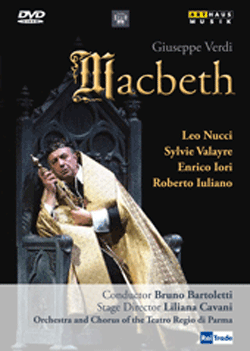
Besides the odd backstage injury or death, an air of box office doom also permeates any staging of Macbeth. Two recent DVDs of opera house performances of Giuseppe Verdi and Francesco Maira Piave’s adaptation give credence to the superstitions, no matter how many tickets may have been sold. What the cameras recorded is fairly dire.
Superficially, both Lilaina Cavalli’s staging for the Teatro Regio di Parma in 2006 and the 2009 Paris Opera work of Dmitri Tcherniakov could be classified as “Regie” productions. In other words, the directors make themselves felt at every almost moment, with their choice of setting and costume, as well as the occasional ostentatious creative touch. For the latter, consider Tcherniakov’s use, between scenes, of stage projections of a Google Earth point of view on a small European town, or Cavalli’s use of a little person in Lady Macbeth’s first scene, said little person sporting, for no discernible reason, a long, thick rat tail.
However, Cavalli just uses some of the clichés of Regie directors to spice up her basically traditional point of view. Viewers can ignore the chorus members in theater-seat rows watching the action at certain points, and the pointless updating of air raid sirens and gun fire just before the overture. When the singers appear, they essentially move and behave as singers of these roles have for decades. Sylvie Valayre’s Lady Macbeth, for example, wears a conventional nightgown and carries a candle holder in her sleep walking scene. Veteran Leo Nucci goes from military regalia to kingly robes, all while wearing a fairly unvaried pained expression.
It’s the worst of both worlds — the distractions of an inept Regie production and the pro-forma stiffness of a dull traditional one. Cavalli is blessed, therefore, to have Leo Nucci as her lead. Nucci is not a great signing actor, but he can be effective, and this is one of his great roles. By the end of the evening — a long sing — gruffness begins to dominate his tone, but for much of the performance, he is in top shape, earning the audience’s passionate adulation. From the slight wobble and tendency to smother the tone, Sylvia Valayre appears to be a soprano with a huge voice just barely within her control. She plays a conventional Lady, stroking her husband’s bare chest when flirtatious, and widening her eyes to convey homicidal passion. The rest of the cast is capable but generic. Roberto Iuliano does sing a rather sweet “ah, la paterna mano.” Bruno Bartoletti, even more veteran than his leading man, gets a proficient reading from the Parma orchestra.
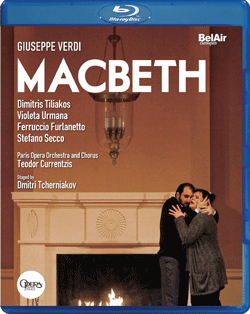
Both Cavalli in Parma and Tcherniakov in Paris opt to spare their singers of Banco a zombie-like reappearance after the character’s murder, instead having their Macbeth alarm the party guests by raving about a man invisible both to them and the audience. After that, there is no comparison between the two productions. Paris wants the “real Regie.” Tcherniakov is quoted in the booklet essay as admitting Macbeth gave him “a world of trouble.” So apparently it was his intent to share that with us. He apparently decided that the world of Macbeth is centered on community, so the main stage is the square of a remarkably neat row of houses apparently constructed by Ikea. For the castle, a frame moves forward with an elegant, high-ceilinged living room in earth tones. In the witch and forest scenes, the chorus — mixed in gender — ambles and roams around the town square. For Banco’s murder, for example, that fine singer Ferrucio Furlanetto basically just gets lost in a crowd of passing strangers in overcoats, and when they part, he is dead on the ground. This distaste for the eerie or supernatural elements of the libretto has its flip side in the best part of Tcherniakov’s direction, the complexity of Macbeth and Lady Macbeth’s relationship. Here we have a couple who are outwardly normal. Circumstances bring out an unexpected blood lust, but they turn to each other with a gentleness not often seen in other productions. The director’s most amazing work is with Violetta Urmana as Lady Macbeth. In other appearances Urmana has used both the amplitude of her voice and her physical self to sink back into prima donna poses. Here, both her vocal work and her acting have a sharp relief that grips the attention, even when Urmana is not at the front of the attention. Almost as strong is Dimitris Tiliakos in the title role. His is not an imposing voice, but he works with it to produce incisive effects. His thinner frame gives him a haunted look, as well as a sense of weakness that draws in the audience’s sympathy. That’s especially potent in the final scene, which Tiliakos plays in a shirt and briefs. Besides the typically imposing Furlanetto, Paris has a credible Macduff in Stefano Secco. A young conductor with appropriate name of Teodor Currentzis exhibits both expected flash and some keen insight into a score that does have its unsubtle moments.
Despite the originality of Tcherniakov’s vision, ultimately this Macbeth simply works too hard to be different than any other Macbeth. There’s always something interesting to observe, but the total impact is much less than the director might have hoped. A 30 minute bonus feature centered on the director will fascinate some, as it delves deep into his working method. Others will find their worst suppositions about the ego of Regie artists extensively confirmed.
If anyone is desperate for a Macbeth on DVD and these two are all that is easily available, consider the Parma one for the star power of Nucci, and the Paris one for Urmana’s amazing work, if not also for some interesting stage pictures and a sense that there is a place for opera in the world of 2011.
Chris Mullins