![Ailyn Pérez as Violetta [Photo © ROH 2011 / Catherine Ashmore]](http://www.operatoday.com/LA%20TRAVIATA%20-%202511ashm_107.png)
02 Dec 2011
Perceptive La Traviata, Royal Opera House
Richard Eyre’s 1994 staging of Verdi’s La Traviata may have been revived many times, but this production reveals striking new depths of interpretation.
English Touring Opera are delighted to announce a season of lyric monodramas to tour nationally from October to December. The season features music for solo singer and piano by Argento, Britten, Tippett and Shostakovich with a bold and inventive approach to making opera during social distancing.
This tenth of ten Live from London concerts was in fact a recorded live performance from California. It was no less enjoyable for that, and it was also uplifting to learn that this wasn’t in fact the ‘last’ LfL event that we will be able to enjoy, courtesy of VOCES8 and their fellow vocal ensembles (more below …).
Ever since Wigmore Hall announced their superb series of autumn concerts, all streamed live and available free of charge, I’d been looking forward to this song recital by Ian Bostridge and Imogen Cooper.
Although Stile Antico’s programme article for their Live from London recital introduced their selection from the many treasures of the English Renaissance in the context of the theological debates and upheavals of the Tudor and Elizabethan years, their performance was more evocative of private chamber music than of public liturgy.
Evidently, face masks don’t stifle appreciative “Bravo!”s. And, reducing audience numbers doesn’t lower the volume of such acclamations. For, the audience at Wigmore Hall gave soprano Elizabeth Llewellyn and pianist Simon Lepper a greatly deserved warm reception and hearty response following this lunchtime recital of late-Romantic song.
For this week’s Live from London vocal recital we moved from the home of VOCES8, St Anne and St Agnes in the City of London, to Kings Place, where The Sixteen - who have been associate artists at the venue for some time - presented a programme of music and words bound together by the theme of ‘reflection’.
'Such is your divine Disposation that both you excellently understand, and royally entertaine the Exercise of Musicke.’
‘And there was war in heaven: Michael and his angels fought against the dragon; and the dragon fought and his angels, And prevailed not; neither was their place found any more in heaven … that old serpent … Satan, which deceiveth the whole world: he was cast out into the earth, and his angels were cast out with him.’
There was never any doubt that the fifth of the twelve Met Stars Live in Concert broadcasts was going to be a palpably intense and vivid event, as well as a musically stunning and theatrically enervating experience.
‘Love’ was the theme for this Live from London performance by Apollo5. Given the complexity and diversity of that human emotion, and Apollo5’s reputation for versatility and diverse repertoire, ranging from Renaissance choral music to jazz, from contemporary classical works to popular song, it was no surprise that their programme spanned 500 years and several musical styles.
The Academy of St Martin in the Fields have titled their autumn series of eight concerts - which are taking place at 5pm and 7.30pm on two Saturdays each month at their home venue in Trafalgar Square, and being filmed for streaming the following Thursday - ‘re:connect’.
The London Symphony Orchestra opened their Autumn 2020 season with a homage to Oliver Knussen, who died at the age of 66 in July 2018. The programme traced a national musical lineage through the twentieth century, from Britten to Knussen, on to Mark-Anthony Turnage, and entwining the LSO and Rattle too.
With the Live from London digital vocal festival entering the second half of the series, the festival’s host, VOCES8, returned to their home at St Annes and St Agnes in the City of London to present a sequence of ‘Choral Dances’ - vocal music inspired by dance, embracing diverse genres from the Renaissance madrigal to swing jazz.
Just a few unison string wriggles from the opening of Mozart’s overture to Le nozze di Figaro are enough to make any opera-lover perch on the edge of their seat, in excited anticipation of the drama in music to come, so there could be no other curtain-raiser for this Gala Concert at the Royal Opera House, the latest instalment from ‘their House’ to ‘our houses’.
"Before the ending of the day, creator of all things, we pray that, with your accustomed mercy, you may watch over us."
The doors at The Metropolitan Opera will not open to live audiences until 2021 at the earliest, and the likelihood of normal operatic life resuming in cities around the world looks but a distant dream at present. But, while we may not be invited from our homes into the opera house for some time yet, with its free daily screenings of past productions and its pay-per-view Met Stars Live in Concert series, the Met continues to bring opera into our homes.
Music-making at this year’s Grange Festival Opera may have fallen silent in June and July, but the country house and extensive grounds of The Grange provided an ideal setting for a weekend of twelve specially conceived ‘promenade’ performances encompassing music and dance.
There’s a “slide of harmony” and “all the bones leave your body at that moment and you collapse to the floor, it’s so extraordinary.”
“Music for a while, shall all your cares beguile.”
The hum of bees rising from myriad scented blooms; gentle strains of birdsong; the cheerful chatter of picnickers beside a still lake; decorous thwacks of leather on willow; song and music floating through the warm evening air.
Richard Eyre’s 1994 staging of Verdi’s La Traviata may have been revived many times, but this production reveals striking new depths of interpretation.
Verdi writes gloriously for Violetta, so it’s a star vehicle for any soprano. But Violetta doesn’t exist in isolation. Although the many great singers who have created the part ensure that Violetta is central to the opera, she doesn’t exist in isolation. The drama revolves around the changing relationships between Violetta, Alfredo and Germont. This current production is important because Piotr Beczala’s Alfredo, brings out the complexity in Alfredo’s personality.This superb performance proves how important highly experienced, high quality casting can be. Beczala is passionate about historic tenor traditions, and this enthusiasm infuses his performance. Please read an interview with him here), La Traviata can be as much about Germont family values as it is about Violetta.
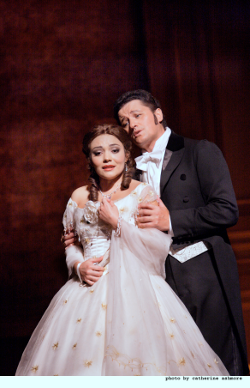 Ailyn Pérez as Violetta and Piotr Beczala as Alfredo
We can perhaps understand why Violetta is in her profession, but Alfredo poses more difficult questions. What kind of man gives up family and status for a demi-mondaine? It’s much more than youthful lust. Even Violetta doesn’t believe him at first, but she’s persuaded by his intensity. Verdi pointedly raises the emotional stakes with the rousing “Libiam ne’lieti calici”. It’s more than a drinking song, it’s a hymn to life.
Because Beczala takes his cue from the music, his Alfredo is infinitely more than a lightweight charmer. The energy in his singing suggests that Alfredo represents an affirmative life-force, in contrast to the shallowness of life on the party circuit. Verdi is making a strong moral statement. Beczala’s Alfredo expresses the strength in the character — firm phrasing, vibrant colour and absolute technical control. Beczala sings the high “Lavero!” at the end of the cabaletta so rings out with a confident flourish. Beczala’s lucid elegance shows that Alfredo’s emotional depth springs from strength of character.
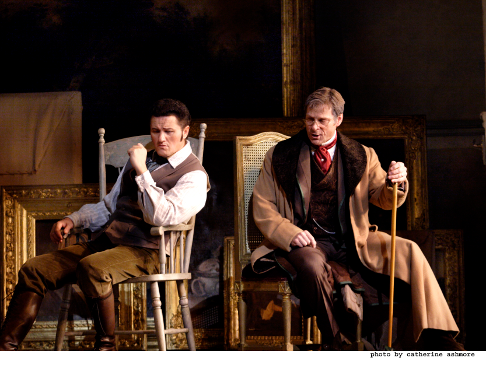 Simon Keenlyside as Giorgio Germont and Piotr Beczala as Alfredo
Beczala’s Alfredo also emphasizes the relation between father and son, a connection sometimes underestimated. Simon Keenlyside sings Giorgio Germont with gravitas. There’s real chemistry between Keenlyside and Beczala. Their dialogues bristle with the bitter energy of shifting father/son power struggle, but the richness of the singing suggests fundamental warmth. One senses that after Violetta is is gone, Alfredo and his father will have an ever stronger connection. Lovely “pura siccome un angelo”, so this family will thrive. Keenlyside’s acting was stiffer than his singing.. He used his stick, not with a swagger, but more as a crutch, as if he had a real life injury. Keenlyside is an athlete and has mishaps. Usually, he’s much more animated.
Expectations were high for Ailyn Peréz after the publicity generated during the Royal Opera House’s Japan tour last year, where she stood in after both Angela Gheorghiu and Ermolena Jaho had to cancel at the last moment. Heroic circumstances. Last month, at the Placido Domingo Celebration, she sang a pleasant if unremarkable Gilda. Her Violetta was attractive enough allowing for uneven intonation and odd phrasing, which she might overcome with experience. One day perhaps she’ll be able to act with her voice, so her gestures come from within. The scene where Violetta squirms in horror as Alfredo enters the casino was unconvincing, though Peréz warmed up, ironically, in the final act. Although Violetta’s music is so well written it cannot help but impress, the role is complex and by no means “pretty”. She’s much more than a projection of male fantasy. Violetta fascinates Alfredo because he can sense in her something others can’t, so whoever sings the part needs to suggest what that special quality might be.
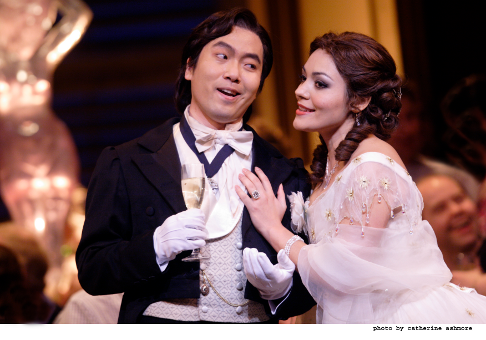 Ailyn Pérez as Violetta and Ji Hyun Kim as Gastone
Rodula Gaitanou was until only last year a Jette Parker Young Artist. Her Haydn L’isola disabitata at the Linbury was very mature for someone so young (read about it here) so it’s good that she’s directing a high profile production like this. In a revival, the moves may be the same, but the way they’re done makes all the difference between dull repeat and fresh enthusiasm. Gaitanou’s clarity illuminates another sub-theme of this opera that’s often overlooked. The gambling table is a metaphor for fate. It’s mechanical, and in Eyre’s original concept, dominates the stage like a juggernaut. The gypsies dance in strict formation, though they sing of freedom. There’s something quite sinister about the bacchanale. So the crowd scenes are tightly executed to express this tension, while subsidiary roles like Flora (Hanna Hipp), Gastone (Jin Hyun Kim), D’Obigny (Daniel Grice), Douphol (Eddie Wade), Dr Grenvil (Christophoros Stamboglis) and Annina (Gaynor Keeble) stand out as individuals, doing justice to excellent singing. It’s a pity that the conducting (Patrick Lange) was erratic, especially since he comes with good credentials (Chief Conductor at the Komische Oper, Berlin).
There’s no such thing as a staging that lets a story tell itself. In a good production, clues are always present if you’re alert to them. Bob Crowley’s set may look “traditional” but it comments powerfully on the drama. In Act One, the diagonals in the set seem to be caving in on the stage, warning that something’s awry. At the centre of the famous country house scene is a doorway which opens onto a trompe-l’œil suggesting many distant doorways beyond. Everything is illusion, even the “books” on the shelves are painted, not real, Grand paintings are haphazardly strewn across the floor. In the final act, behind Violetta’s deathbed looms a giant picture frame covered in black, as portraits used to be covered when a person died. For a brief moment, Alfredo’s image is projected onto the cloth, but fades. Mirrors, dressmaking dummies, huge, overpowering shutters, all of which add to meaning. This is a beautiful production but it’s also intelligent. With casts like this, revivals are fully justified.
Anne Ozorio