26 May 2012
Garsington Opera at Wormsley
Director David Freeman tells why this is an event worth experiencing in the Olympic year.
‘A brief history of song’ is the subtitle of the 2020 Oxford Lieder Festival (10th-17th October), which will present an ambitious, diverse and imaginative programme of 40 performances and events.
‘Signor Piatti in a fantasia on themes from Beatrice di Tenda had also his triumph. Difficulties, declared to be insuperable, were vanquished by him with consummate skill and precision. He certainly is amazing, his tone magnificent, and his style excellent. His resources appear to be inexhaustible; and altogether for variety, it is the greatest specimen of violoncello playing that has been heard in this country.’
Eboracum Baroque is a flexible period instrument ensemble, comprising singers and instrumentalists, which was founded in York - as its name suggests, Eboracum being the name of the Roman fort on the site of present-day York - while artistic director Chris Parsons was at York University.
‘There could be no happier existence. Each morning he composed something beautiful and each evening he found the most enthusiastic admirers. We gathered in his room - he played and sang to us - we were enthusiastic and afterwards we went to the tavern. We hadn’t a penny but were blissfully happy.’
When soprano Eleanor Dennis was asked - by Ashok Klouda, one of the founders and co-directors of the Highgate International Chamber Music Festival - to perform some of Beethoven’s Scottish Songs Op.108 at this year’s Festival, as she leafed through the score to make her selection the first thing that struck her was the beauty of the poetry.
“At the start, one knows ‘bits’ of it,” says tenor Mark Padmore, somewhat wryly, when I meet him at the Stage Door of the Royal Opera House where the tenor has just begun rehearsals for David McVicar’s new production of Death in Venice, which in November will return Britten’s opera to the ROH stage for the first time since 1992.
“Trust me, I’m telling you stories …”
When British opera director Nina Brazier tries to telephone me from Frankfurt, where she is in the middle of rehearsals for a revival of Florentine Klepper’s 2015 production of Martinů’s Julietta, she finds herself - to my embarrassment - ‘blocked’ by my telephone preference settings. The technical hitch is soon solved; but doors, in the UK and Europe, are certainly very much wide open for Nina, who has been described by The Observer as ‘one of Britain’s leading young directors of opera’.
“We need to stop talking about ‘diversity’ and think instead about ‘inclusivity’,” says Bill Bankes-Jones, when we meet to talk about the forthcoming twelfth Tête à Tête Opera Festival which runs from 24th July to 10th August.
The young Hong Kong-born British composer Dani Howard is having quite a busy year.
For Peter Sellars, Mozart’s Idomeneo is a ‘visionary’ work, a utopian opera centred on a classic struggle between a father and a son written by an angry 25-year-old composer who wanted to show the musical establishment what a new generation could do.
“Physiognomy, psychology and technique.” These are the three things that determine the way a singer’s sound is produced, so Ken Querns-Langley explains when we meet in the genteel surroundings of the National Liberal Club, where the training programmes, open masterclasses and performances which will form part the third London Bel Canto Festival will be held from 5th-24th August.
“Sop. Page, attendant on the King.” So, reads a typical character description of the loyal page Oscar, whose actions, in Verdi’s Un ballo in maschera, unintentionally lead to his monarch’s death. He reveals the costume that King Gustavo is wearing at the masked ball, thus enabling the monarch’s secretary, Anckarstroem, to shoot him. The dying King falls into the faithful Oscar’s arms.
A mournful Princess forced by her father into an arranged marriage. A Prince who laments that no-one loves him for himself, and so exchanges places with his aide-de-camp. A melancholy dreamer who dons a deceased jester’s motley and finds himself imprisoned for impertinence.
‘Aloneness’ does not immediately seem a likely or fruitful subject for an opera. But, loneliness and isolation - an individual’s inner sphere, which no other human can truly know or enter - are at the core of Yasushi Inoue’s creative expression.
What links Wagner’s Das Rheingold, Donizetti’s Anna Bolena, Mozart’s Don Giovanni and Cavalli’s La Calisto? It sounds like the sort of question Paul Gambaccini might pose to contestants on BBC Radio 4’s music quiz, Counterpoint.
Though she won praise from the literary greats of her day, including Thomas Hardy, Virginia Woolf, Ezra Pound and Siegfried Sassoon, the Victorian poet Charlotte Mew (1869-1928) was little-known among the contemporary reading public. When she visited the Poetry Bookshop of Harold Monro, the publisher of her first and only collection, The Farmer’s Bride (1916), she was asked, “Are you Charlotte Mew?” Her reply was characteristically diffident and self-deprecatory: “I’m sorry to say I am.”
“It lives!” So cries Victor Frankenstein in Richard Brinsley Peake’s Presumption: or the Fate of Frankenstein on beholding the animation of his creature for the first time. Peake might equally have been describing the novel upon which he had based his 1823 play which, staged at the English Opera House, had such a successful first run that it gave rise to fourteen further adaptations of Mary Shelley’s 1818 novella in the following three years.
It sounds like a question from a BBC Radio 4 quiz show: what links Handel’s cantata for solo contralto, La Lucrezia, Samuel Beckett’s Krapp’s Last Tape, and the post-punk band Joy Division?
The first two instalments of the Academy of Ancient Music’s ‘Purcell trilogy’ at the Barbican Hall have posed plentiful questions - creative, cultural and political.
Director David Freeman tells why this is an event worth experiencing in the Olympic year.
Garsington Opera built its reputation on operatic rarities and baroque in particular. David Freeman has directed all three productions of Vivaldi’s operas here, with baroque specialist Laurence Cummings conducting. “We did L’Incoronazione de Dario, from Vivaldi’s early period, La Verità in cimento (see review) last year, and now L’Olimpiade, from much later. This is probably the finest - we’ve saved best for last”. Though, hopefully there will be more Vivaldi at Garsington Opera at Wormsley. “Vivaldi said he wrote around 70 operas, though some may have been pastiches. We don’t have them all, but there are over 20 that can be done”. “Vivaldi was an extraordinary person, with bright red hair. He was a priest and ran his own opera company where he did everything, composer, producer, music director. His orchestra was all-female, which at the time was very unusual, and the stories around him are lurid” says Freeman.
“L’Olimpiade is an Oedipus Rex story says Freeman. An athlete called Megacles competes in the Olympics. The prize is the hand of the princess Aristea. Megacles and Aristea love each other but he’s won under the name of Licidas, his friend, who is in turn loved by Argene. When the King hears about the deception, he banishes Licidas, who then is drawn into a plot to assassinate the King. But Licidas turns out to be the king’s own son, supposedly killed at birth because of a prophecy that he’ll grow up to kill his father. In Vivaldi’s version, the plot resolves with the right pairs of lovers reunited, and Licidas becomes prince. “It seems very complicated”, Freeman adds, “until you see it, and then it all makes sense. A bit like Shakespeare’s Twelfth Night”.
Freeman has directed a lot of Shakespeare, including Twelfth Night. Indeed, he’s a complete man of the theatre, with huge and varied experience. He directed Prokofiev The Fiery Angel at the Royal Opera House, the Kirov and San Francisco, the premiere of Sir Harrison Birtwistle’s The Mask of Orpheus, and Philip Glass’s Akhnaten. He was associated with names like Peter Brook, and founded The Opera Factory which was closely associated with The English National Opera in its “powerhouse” days. He’s also directed mainstream spectacles like Madama Butterfly and Carmen at the Royal Albert Hall. He’s worked in film, too, and is directing a multimedia Handel Messiah in Copenhagen next year.
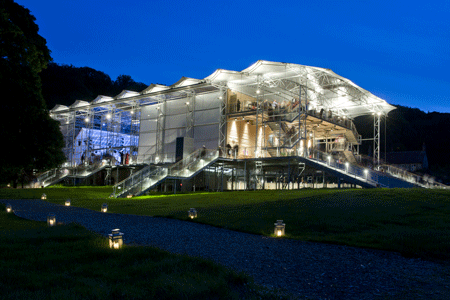 Garsington Opera at Wormsley [Photo: Richard Davies]
Thus it was an education to watch him direct a rehearsal of L’Olimpiade. They were doing a scene where Aristea (Rosa Bove) learns that she’s to be married to a stranger. Bove is embracing a toy lamb. The King Clistene (Riccardo Novaro) enters and quietly removes the toy sheep. “She has to grow up now and be married” says Freeman. Novaro deposits the lamb behind a rock, out of Bove’s sight. It’s a small gesture, lasting under a minute, but Freeman shows how it expresses the King’s purposeful nature. “Don’t look at the lamb” Freeman tells Novaro. Clistene isn’t interested in sheep but in his daughter and her coming of age.
At Garsington Opera at Wormlsey, real sheep roam the fields, but inside the auditorium, life size models of sheep move across the stage, pulled on wires. Of course it’s artifice. This is theatre, not nature, and Argene (Ruby Hughes) is a noblewoman, pretending to be a shepherdess as part of her strategy to win Licidas. In a bare rehearsal room, and out of context, it’s even less naturalistic, but Freeman tells the cast that the feelings in the opera are real. They have to play the scene seriously, or the irony is lost. “The audience will only find it funny if we take it completely seriously”. Some great comedians, he adds later, are very serious people: comedy throws tragedy into high relief.
“L’Olimpiade’s an Oedipus story, it’s a curse, but when Lycidas comes to kill his father he can’t bring himself to do it. It’s a tragedy but ends up as comic. We have to laugh at the most serious things. It’s extraordinary that the one thing we can rely on in life is that we’re going to die, but it’s the one thing we can’t avoid”. “L’Olimpiade is a comedy, but a comedy for serious characters, not light”, Freeman adds. “It’s a very dramatic and vigorous comedy. People try and commit suicide. It reminds me of Chikamatsu, who created those kabuki double suicide tragedies But in Vivaldi they don’t it follow through”. “What you have to do is make the recitatives work, which is true of Mozart, too. They work like dialogues in a play. You’ve got to play with great clarity. Good singers and actors of course know their text but the hard thing is that you have to learn everyone else’s text so you can react to it”. Characters make drama, whether in a play or in an opera. “An opera without drama is a very long evening indeed”.
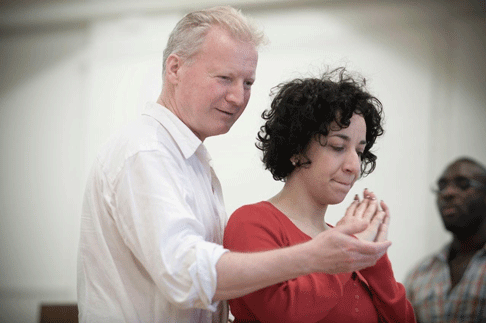 David Freeman directing Rosa Bove in rehearsals for Vivaldi
L’Olimpiade
David Freeman directing Rosa Bove in rehearsals for Vivaldi
L’Olimpiade
In L’Olimpiade, Freeman says there is some “absolutely beautiful music and it’s genuinely touching too. It’s not just pretty tunes. The music cuts pretty deep, even if the plot’s a concoction”. L’ Olimpiade is based on a text by Metastasio which was also used in other operas. Audiences would have had printed texts available, though not sheet music which was expensive to copy, so the plots would not have been wholly unfamiliar. “So there wasn’t the same close relationship between text and music that you get in Mozart or even in Monteverdi". Contemporary audiences might have enjoyed these operas much in the way that popular modern shows string together good tunes around a storyline.
“Another thing about Vivaldi”, says Freeman, “is that we tend to think of baroque as Handel. They were almost direct contemporaries, Vivaldi (1678-1741), Handel (1685-1759). But Handel was a German composer writing in Italian for an English audience, so naturally he didn’t go in for very complicated plots but for rather sublime situations. Vivaldi is different. He’s a Venetian writing for Italians, even in the Venetian dialect, for Venetian audiences, who could understand . So he was able to do a lot more, with text, with comic wit, a lot more madness. So there are more arias, even if they’re shorter, and lots more recitative. So in comparison with Handel who can seem quite noble, Vivaldi might seem more scrappy, but that’s what makes Vivaldi lively”.
Garsington Opera's new premises at Wormsley were designed to combine the countryside setting with good acoustics. "I love the way it seems to float in the open field", says Freeman, "it's surreal". This works particularly well for baroque scale works. Freeman directed A Winter's Tale one of the first plays to be mounted in the Globe theatre in London, a reconstruction of Shakepeare's original theatre. "People said that it proved the primacy of Shakespeare's text, all you need is text. But I thought the opposite. I thought the Globe setting revitalized everything. In a normal theatre, if a pigeon flies in, the audience worries, will it die, or get electrocuted? They get distracted from the play. But in the Globe, if a bird flies in, it's natural, it's just doing what birds do. And the atmosphere at Wormsley rubs off on the operas too. I think it's a triumph".
For more information, please see the Garsington Opera at Wormsley site. (includes cast and production shots)
Anne Ozorio