Subscribe to
Opera Today

Receive articles and news via RSS feeds or email subscription.


twitter_logo[1].gif


UCP_9780226043425.gif

Recently in Recordings

Ariane et Barbe-Bleue on Blu-Ray

Paul Dukas’ Ariane et Barbe-Bleue, first heard in 1907, once seemed important. Arturo Toscanini conducted the Met premiere in 1911 with Farrar and later arranged some of its music for a 1947 recording with his NBC Symphony.

Kaufmann Wagner

The economics of the recording companies dictate much that is not ideal. Wagner’s operas were not composed as they were in order to permit the extraction of bleeding chunks, even on those occasions when strophic song forms do occur.

Mahler: Symphony No. 8

Among the recent recordings of Mahler’s Eighth Symphony, Valery Gergiev’s release on the LSO Live label is an excellent addition to the discography of this work.

Songs by Zemlinsky

While not unknown, the songs of Alexander von Zemlinsky (1871-1942) deserve to be heard more frequently.

Gustav Mahler: Lieder eines fahrenden Gesellen, Rückert-Lieder, Kindertotenlieder.

Recorded on 5 and 6 May 2008 and 17 and 18 January 2009 at the Lisztzentrum (Raiding, Austria), this recent Bridge release makes available the piano-vocal versions of three song cycles by Gustav Mahler, Lieder eines fahrenden Gesellen, Rückert-Lieder, and Kindertotenlieder performed by mezzo-soprano Hermine Haselböck, accompanied by Russell Ryan.

Kathleen Ferrier: A Film by Diane Perelsztejn

Contraltos rarely achieve the acclaim and renown of sopranos. Assigned few leading roles in opera, they are condemned to playing the villain or the grandmother, or to stealing the castrati’s trousers in en travesti roles.

1612 Italian Vespers

Following their 2011 Decca recording of Striggio’s Mass in 40 Parts (1566), I Fagiolini continue their quest to unearth lost treasures of the High Renaissance and early Baroque, with this collection of world-premiere recordings, ‘reconstructions’ and ‘reconstitutions’ of music by Giovanni and Andrea Gabrieli, Monteverdi, Palestrina, and their less well-known compatriots Viadana, Barbarino and Soriano.

Eternal Echoes: Songs and Dances for the Soul

Eternal Echoes is an album of khazones [Jewish cantorial music] for cantorial soloist, solo violin and a blended instrumental ensemble comprising a small orchestra and the Klezmer Conservatory Band.

Mahler: Symphony no. 3 / Kindertotenlieder

Michael Tilson Thomas’s recording of Mahler’s Third Symphony is an outstanding contribution to the composer’s discography.

Oliver Knussen’s Symphonies from NMC

Oliver Knussen burst into British music with an unprecedented flourish. In 1967, the London Symphony Orchestra premiered Knussen’s First Symphony, with István Kertész scheduled to conduct.

Ludwig van Beethoven: Fidelio

Based on performances given in Summer 2010 at the Lucerne Festival, this recording of Beethoven’s Fidelio is an admirable recording that captures the vitality of the work as conducted by Claudio Abbado.

Stanisław Moniuszko: Flis

Stanisław Moniuszko (1819-1872) was one of the most popular composers of his day in Poland, and of the many works he wrote for the stage, two are performed from time to time, Halka (1848) and Strazny dwór [The Haunted Manor] (1865).

Stanisław Moniuszko: Pieśni Songs

The Polish alto Jadwiga Rappé is a familiar voice in various stage and concert works, and the recent release of a selection of songs by Stanisław Moniuszko (1819-1872) is an opportunity to hear her performing artsongs.

Joan Sutherland and Richard Bonynge: Serate Musicali

Originally released on multiple discs in 1981 this reissue on two CDs is a comprehensive collection of art songs by Italian and French composers from the nineteenth and early twentieth centuries.

Richard Strauss: Salome

An exciting contribution to the discography of this popular opera, the live performance of Richard Strauss’s Salome from the Festspielhaus at Baden-Baden is a compelling DVD.

Lulu by Gran Teatro del Liceu, Barcelona

Released in late 2011, Deutsche Grammophon’s DVD of the new staging of Berg’s Lulu at the Gran Teatro del Liceu, Barcelona is an excellent contribution to the discography of this fascinating opera.

Lulu by the Metropolitan Opera

A recent release by the Metropolitan Opera, this two-disc set makes available on DVD the famous performance of Berg’s Lulu that was broadcast on 20 December 1980 as part of the PBS series “Live from the Met.”

Elmer Gantry the Opera

The novels of Sinclair Lewis once shot across the American literary skies like comets, alarming and fascinating readers of that era, but their tails didn’t extend far behind them.

Historical Performances from Covent Garden: Barbiere, La traviata and Tosca

Once the province of only the most dedicated opera fanatics, mid-20th century recordings of privately taped live performances have become more widely available.

Lucia and the glass harmonica

Flute players in opera orchestra around the world must look forward to the frequent appearances of Donizetti’s Lucia di Lammermoor, knowing that while the stage spotlight in the mad scene will be on the soprano, the orchestral spotlight will be on their instrument.

OPERA TODAY ARCHIVES »

Recordings

26 Jun 2005

BARBER: Orchestral Works

EMI has re-released a 2-disc set of some of Samuel Barber’s most compelling orchestral and chambers works on the Gemini — The EMI Treasures label. An album of the same recordings was released in 2001, itself a remastering of original recordings dating from the mid-1980s through the mid-1990s. Disc 1 from both these sets contains music recorded in 1986 and 1988 with the St. Louis Symphony Orchestra conducted by Leonard Slatkin and released in 1990 as a single disc. The second disc of the set contains chamber music of Barber, recorded in 1995. Each time this music has been released it has received positive reviews. See for example, Jon Yungkans’s review on the The Flying Inkpot; the reviews on Amazon.com; or Victor Carr’s review on Classics Today.

Samuel Barber: Orchestral Works
Elmar Oliveira (violin) and others
St. Louis Symphony Orchestra, Leonard Slatkin (cond.)
EMI Classics 7243 5 86561 2 1 [2CDs]
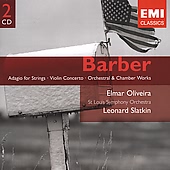
EMI has re-released a 2-disc set of some of Samuel Barber's most compelling orchestral and chambers works on the Gemini — The EMI Treasures label. An album of the same recordings was released in 2001, itself a remastering of original recordings dating from the mid-1980s through the mid-1990s. Disc 1 from both these sets contains music recorded in 1986 and 1988 with the St. Louis Symphony Orchestra conducted by Leonard Slatkin and released in 1990 as a single disc. The second disc of the set contains chamber music of Barber, recorded in 1995. Each time this music has been released it has received positive reviews. See for example, Jon Yungkans's review on the The Flying Inkpot; the reviews on Amazon.com; or Victor Carr's review on Classics Today.

On one hand, EMI's decision to recycle recordings is frustrating — it would be nice to hear some new performers and different interpretations, or to have access to some of Barber's less frequently performed works. On the other hand, Slatkin and the St. Louis Symphony Orchestra do such a lovely job with this music that the availability of so many affordable options is not to be scorned.

The cover of this most recent release features a small, tattered American flag attached to what can be imagined to be a Midwestern mailbox, rusted and tilted to one side, with tall grass sprouting up from the ground below. The rustic scenery and the American symbolism poses the question, how American is Barber's music? Or rather, has Barber's music been perceived as American by critics and listeners?

Barber has long been received as a neo-Romantic, and his sound associated with a more European, post-Straussian sound. Rarely is Barber's name included in the inventory of American composers that is comprised of such seekers of an American-sounding music as Aaron Copland, Virgil Thomson, Roy Harris, and Leonard Bernstein, among others. Barber's exclusion from this catalogue has more to do with the way his music sounds than with his birthplace or national allegiances.

Barber was born in West Chester, PA, educated at the Curtis Institute in Philly, and he lived and worked for much of his life in Mount Kisco, NY. Barber sought some of his musical education abroad, spending several years in Italy on a Rome Prize. Barber's traveling and studying in Europe was not unusual; Copland, Thomson, Harris, and Bernstein also spent time studying with Europeans as they developed a distinctive American music.

In a 1939 article — "Modern American Composers" — David Ewen wrote about the then twenty-nine-year-old Barber that "[Barber] now promises to become the most important discovery in American music since Roy Harris1." It is interesting to note that at that early stage in Barber's career, Ewen compared him to a composer who actively and aggressively cultivated his "American-ness," and whose music was regarded as the epitome of American-sounding music. Furthermore, Ewen goes on to suggest that in the future Barber, because of his talent and skills, will contribute to further developing an American musical tradition.

A mere nine years later, in 1948, another article on Barber's music appeared — this one by Nathan Broder titled "The Music of Samuel Barber." Broder gives a summary of Barber's works up to that point, and he is careful to defend Barber against the label, "neo-Romantic." Broder claims that the use of tonality in Barber's more recent works is a "return" to an earlier style and a technique employed to evoke a particular mood, rather than a consistent part of Barber's musical vocabulary2.

While it is true that in his works from the 1940s Barber did use more dissonance, syncopation, and serial techniques than in his earliest works, history has proven that Barber really is more of a neo-Romantic than not. His later large works such as his operas, Vanessa (1957) and Anthony and Cleopatra (1966, rev. 1975), are predominantly tonal and feature Barber's well-known lyrical melodies, as well as a dose of post-Straussian chromaticism.

When compared to his contemporaries, Barber's music simply sounds less "American." Barber rarely uses American folk or popular song quotations, nor does he often employ jazz or popular styles in his music. One of the few pieces in which Barber does refer to American musical idioms is included in this CD set — Excursions (1941 - 2); however, Barber's "most American" piece — Knoxville: Summer of 1915 (1947) is not.

I suspect that EMI's decision to evoke American imagery on re-release of an already re-released album says more about the political climate and marketing strategies in the United States right now than it does about Barber's music or his position as an American composer. The choice of a tattered American flag — waving bravely and persistently despite the weathering it has endured — reads as an attempt to capitalize on the surge of post-9/11 patriotism.

Although Barber is an American composer, the rural imagery on the CD cover does not speak to the America that Barber knew — the east coast cities or the upstate-NY village of Mt. Kisco. One would hope that the high quality of the performances and the popularity of the works on the recording would sell themselves.

Megan Jenkins
CUNY The Graduate Center


1 David Ewen, "Modern American Composers," in The Musical Times 80/1156 (June 1939): 415.

2 Nathan Broder, "The Music of Samuel Barber," in The Musical Quarterly 34/3 (July 1948): 325 - 335.

Send to a friend

Send a link to this article to a friend with an optional message.

Friend's Email Address: (required)

Your Email Address: (required)

Message (optional):