Subscribe to
Opera Today

Receive articles and news via RSS feeds or email subscription.


Recently in Recordings

Le Monde Reviews Lamento

Cela arrive rarement, le souffle coupé dès les premières notes. Une minute entière à retenir sa respiration dans une apnée d’émotion totale pour recevoir la première phrase du Lamento pour contralto, de Johann Christoph Bach, d’après les Lamentations de Jérémie, son ascension douloureuse, ornée de sanglots, puis les deux accords d’une longue plainte instrumentale, avant l’entrée, magique, de la voix de Magdalena Kozena. “Ach, dass ich Wassers g’nug hätte.” “Ah, si ma tête était remplie d’eau, si mes yeux étaient une source de larmes.” L’insouciance a été jusqu’alors votre lot ? Vous, toi, nous tous, pécheurs, allons connaître ce que pèse le lourd fardeau de nos iniquités – et la récompense de cette connaissance : 7 minutes 22 d’une pure splendeur musicale.

MOZART: Le Nozze di Figaro

Recorded in Tokyo on October 23, 1963, this live recording of Nozze di Figaro boasts fine sound, a top cast, and the leadership of a conductor of great skill and experience. The label, Ponto, has joined the ranks of such other companies as Opera D’oro and Gala in making available broadcast and in-house recordings at affordable prices. Sometimes these releases are not even worth the modest price asked for; this one may well have more to offer than higher-priced studio sets. After a slightly hesitant first few moments, the sound quality settles down and becomes admirably strong and well defined. There is relatively little stage noise, the voices have a natural presence without being too forwardly placed, and Böhm’s orchestral control can be relished. His may be an old-fashioned reading, but it never lags or lacks for humor or beauty. The audience can be heard laughing from time to time at the stage antics; applause only interferes with the musical pleasures at the end of Non piu andrai, when unrestrained clapping covers a bit of Böhm’s ironically happy martial send-off.

WAGNER: Tristan und Isolde

Elsewhere on Opera Today readers can find a recent review of a live recording of Mozart’s Le Nozze di Figaro from the Ponto label, a company that has joined the ranks of Opera D’oro and Gala in offering, at budget price, live recordings of various provenance. At their best, as with that Nozze, these recordings offer in acceptable sound (sometimes better) performances of such quality they rival their more expensive competitors. At less than the best, however, even the budget price becomes exorbitant. This Tristan und Isolde, recorded on January 25, 1967, unfortunately belongs to the latter category. Unless one has a strong personal reason for wanting a keepsake of this company or the artists involved, the recording is unlikely to please most listeners. The primary reason is the sound. While not unlistenable, the recording is clearly an “in-house” affair, and probably from an audience member, as some of the coughing is more up-front than the singing. Worse, during the climax, some audience members are whispering as Isolde enters the Leibestod. One would love for a Jon Vickers to have been present to yell out, “Stop your damn whispering!”

BOLCOM: Songs of Innocence and of Experience

William Bolcom is arguably the preeminent American opera composer of today. His third commission for Lyric Opera of Chicago, A Wedding, recently opened to mostly positive reviews. His previous work in the form, A View from the Bridge, had a successful run at the Metropolitan Opera following its premiere in Chicago.

VERDI: Il Trovatore

Il Trovatore Giuseppe Verdi, music and Salvatore Cammarano and Leone Emanuele Bardare, libretto TDK DVUS-CLOPIT Raina Kabaivanska (Leonora) Fiorenza Cossotto (Azucena) Plácido Domingo (Manrico) Piero Cappuccilli (Conte di Luna) José van Dam (Ferrando) Maria Venuti (Inez) Heinz Zednik (Ruiz) Karl...

BACH: Matthäus-Passion

On an accompanying CD and in the liner notes, interviewer Klaus J. Schönmetzler asks conductor Enoch zu Guttenberg, “Why another St. Matthew Passion?” This is a fair question considering the glut of recordings ranging from the overtly romantic to the idealized “authentic” (and mostly fast) Baroque editions. To his credit, Guttenberg responds to this question by acknowledging an aversion to interpreting Bach overly Romantically while desiring a Baroque sensibility. As a theologian, zu Guttenberg understands an undeniable conviction in Bach’s theology, particularly in the chorales, which he acknowledges can lead to a more Romantic interpretation. Zu Guttenberg’s attempt to capture this devotion coupled with the reality of twenty-first century instruments and performers, produces a St. Matthew stuck in a mediocre middle ground between a Baroque “ideal” and a Romantic interpretation.

Lamento with Magdalena Ko

The imposing figure of Johann Sebastian Bach has loomed large for Magdalena Koená throughout her career. It was her first disc of Bach arias on Deutsche Grammophon’s Archiv label that brought the golden-voiced mezzo to the attention of the music world as early as 1997. Word then quickly went round that Magdalena was the perfect choice for Bach recordings. ”This disc that started my international career also was my introduction to the great Baroque conductors, including the wonderful scholar and musician Reinhard Goebel, with whom I’ve worked on my new disc, Lamento.” Although the title may suggest wailing and gnashing of teeth, this is a sublime and eclectic mixture of music by J. S. Bach, his relations and contemporaries. ”There’s a very optimistic feeling to this CD,” says Koená. ”Although all these pieces are about how horrible it is on this earth, they are really celebrating how great it will be afterwards. There’s a message of hope throughout.”

Gramophone Reviews Le Comte Ory

Colour, wit and life abound with a star turn from the Rossini tenor of the moment Comte Ory Le Comte Ory is the first great French-language comic opera. A late work (Paris, 1828), sensuous, witty and exquisitely crafted, it has...

Bullfrog Films' Don Giovanni: Leporello’s Revenge

Don Giovanni: Leporello's Revenge Mozart's opera presented from the point of view of Don Giovanni's servant, Leporello. 55 minutes Color / Stereo Copyright Date: 2000 ISBN: 1-56029-885-5 Mozart's Don Giovanni is arguably one of his most complex, politically controversial, and...

Le Monde Reviews Verdi's Falstaff from Andante

Deux "Falstaff", à vingt ans d'écart LE MONDE | 27.12.04 | 14h05 Les amateurs d'opéra ont, généralement, un fort penchant pour l'écoute comparée des interprétations. L'éditeur Andante les comblera. Dans un somptueux livre-CD (224 pages avec notice et livret en...

ROSSINI: Zelmira

Zelmira Gioachino Rossini, music and Andrea Leone Tortola, libretto ORC 27 Scottish Chamber Orchestra Maurizio Benini, conductor Besides its Opera in English series on Chandos, Peter Moore's Foundation has sponsored the recording of many a fine bel canto rarity on...

AMOR: Richard Strauss — Opera Scenes and Lieder

French soprano Natalie Dessay sings three roles, all quite different in character and personality -- from Zerbinetta in "Ariadne" to Zdenka in "Arabella" and Sophie in "Rosenkavalier." It is a delicious way to sample the pleasures of this great singer....

RAUTAVAARA: The House of the Sun

The House of the Sun Einojuhani Rautavaara, music and libretto Ondine 1032-2D Oulu Symphony orchestra Mikko Franck, conductor The recording company Ondine, based in Helsinki, has built itself an international reputation, at least arguably, by dedicating itself to the works...

VERDI: A Masked Ball

A Masked Ball Giuseppe Verdi, music and Antonio Somma, libretto English translation by Amanda Holden Chandos 3116 (2) London Philharmonic Orchestra David Parry, conductor In an era where major record companies seldom produce complete opera sets (and those they do...

STRAUSS: Der Liebe der Danae

STRAUSS Der Liebe der Danae, op. 83 * Ulrich Windfuhr, cond; Franz Grundheber (Jupiter); Manuela Uhl (Danae); Hans-Jürgen Schöpflin (Mercury); Robert Chafin (Midas); Paul McNamara (Pollux); Cornelia Zach (Xanthe, Europa); Daniel Behle, Martin Fleitmann, Simon Pauly, Hans Georg Ahrens (Vier...

Myto Releases Spontini's Agnese di Hohenstaufen

SPONTINI: Agnese di Hohenstaufen Lucille Udovick (Agnese), Dorothy Dow (Irmengarda), Franco Corelli (Enrico il Palatino), Francesco Albanese (Filippo), Enzo Mascherini (Re di Francia), Anselmo Colzani (Enrico il Leone), Gian Giacomo Guelfi (L'Imperatore); Florence Teatro Communale/ Vittorio Gui Myto 42084 [2CD]...

Myto Releases Ernani

VERDI:Ernani with Giovanna d'Arco excerpts Georgio Merighi (Ernani), Piero Cappuccilli (Don Carlo), Augusto Ferrin (De Silva), Mara Zampieri (Elvira) Trieste Teatro Communale/ MolinariPradelli; Mara Zampieri (Giovanna), Renato Francesconi (Carlo), Ettore Nova (Giacomo) San Remo Symphony/ Buenza-Delil Myto 41288 [2CD] 148...

Myto Releases Otello

VERDI: Otello Mario del Monaco (Otello), Renata Tebaldi (Desdemona), Leonard Warren (Iago); La Scala/ Antonio Votto Myto 41083 [2CD] 140 minutes Tebaldi and Del Monaco twice recorded Otello together in the studio, and we've reviewed a number of bootlegs starring...

ARG Reviews Mercadante's Emma d'Antiochia

MERCADANTE: Emma d'Antiochia Nelly Miricioiu (Emma), Maria Costanza Nocentini (Adelia), Bruce Ford (Ruggiero), Roberto Servile (Corrado); Geoffrey Mitchell Choir, London Philharmonic/ David Parry Opera Rara 26 [3CD] 183 minutes I have long been on a campaign to revive the works...

Fanfare Reviews Jenufa

JANáCEK Jenufa * Charles Mackerras, cond; Janice Watson (Jenufa), Josephine Barstow (The Kostelnicka), Nigel Robson (Laca), Peter Wedd (Steva), Neale Davies (Foreman); Welsh Natl Op O & Ch * CHANDOS 3106 (2 CDs: 121: 11) There is so much to...

OPERA TODAY ARCHIVES »

Recordings

Bryn Terfel: Un Canu Caneuon
21 Oct 2005

Walisische Lieder sind eine Entdeckung wert

Das walisische Label SAIN (das walisische Wort für "Sound"), gegründet 1969 von Dafydd Iwan, Huw Jones und Brian Morgan Edwards, hat einen starken sozialen und politischen Anspruch und ist darauf spezialisiert, CD's mit jungen Sängern und Liedern aus Wales und in walisischer Sprache herauszubringen.

  • Bryn Terfel (Vol. 1)
    SAIN SCD9032
  • Bryn Terfel (Vol. 2)
    SAIN SCD9099
  • Bryn Terfel: Schwanengesang
    SAIN SCD4035
  • Bryn Terfel: Un Canu Caneuon
    SAIN SCD2013
  • Rhys Meirion: Pedair Oed
    SAIN SCD2438


So wundert es nicht, daß die ersten CD's des weltberühmten walisischen Bass-Baritons Bryn Terfel unter diesem Label entstanden sind. 1988, das Jahr, in dem Bryn Terfel das Kathleen-Ferrier-Memorial Stipendium erhalten hatte, erschien seine erste CD. Sein Operndebüt stand ihm noch bevor, und die Zusammenstellung der CD wirkt etwas wie die unzusammenhängende Aneinanderreihung von Vorsingarien. Neben walisischen Liedern von Idris Lewis, R. Vaughan Williams, Eric Jones, Vincent Davies, W. Mathews Williams, Osborne Roberts, W. Bradwen Jones und 2 traditionellen Liedern arrangiert von der Pianistin Annette Bryn Parri finden sich Schuberts "Fischermädchen", Mozarts "Non più andrai", Gounods "Vous qui faites l'endormie", Händels "But who may abide the day of his coming?", Tostis "Ideale" und Franco Leonis "Tally-Ho!". Das mag dramaturgisch seltsam sein, zeigt aber auch die große Bandbreite des jungen am Anfang seiner Karriere stehenden Sängers. Die wunderschöne, kernige und technisch mühelose Stimme klingt auf dieser CD bisweilen etwas erschöpft oder noch nicht ganz ausgereift, was aber den Hörgenuß nicht mindert. Das Booklet ist sehr sparsam gehalten, mit kurzer Beschreibung der Lieder in englisch. Über die teilweise nicht sehr bekannten walisischen Komponisten erfährt man hier nichts.

1990 erschien wieder unter dem Label SAIN die zweite CD von Bryn Terfel mit dem Titel "Cyfrol2-Volume2". Das Booklet ist noch spärlicher als bei dem Debütalbum. Die Herausgeber haben sich teilweise nicht die Mühe gemacht, die Komponisten der einzelnen Stücke zu nennen. Die Zusammenstellung ist ähnlich beliebig wie bei der ersten CD. So finden wir hier die bekannte Arie aus "The Fiddler on the Roof" in walisischer Sprache, drei wunderschöne walisische Lieder von Meirion Williams, Schuberts "Ständchen", eine Arie aus dem Musical "South Pacific", eine Händel-Arie aus "Judas Maccabäus" mit Klavierbegleitung - von Bryn Terfel wunderbar gesungen! -, Lieder von William Davies, W. Albert Williams, John Ireland, Mansel Treharne Thomas und Richard Samuel Hughes, eine Kanzonette von Haydn, die Mantel-Arie aus "La Bohème", Don Giovannis "Serenade" - alles mit Klavierbegleitung. Bryn Terfels Stimme ist wunderschön, in seiner eigenen Sprache vollkommen locker, frei und leicht. Auch die Opernarien lassen die Weltkarriere des großartigen Sängers voraushören. Die walisischen Lieder sind eine Entdeckung wert. Man würde diesen unbekannten Kompositionen nur ein ausführlicheres Booklet wünschen.

Im Jahr darauf, 1991, nahm SAIN mit Bryn Terfel und dem inzwischen weltbekannten Liedbegleiter Malcolm Martineau Schuberts "Schwanengesang" auf. Die Aufnahme ist stimmlich, technisch und musikalisch hervorragend. Bryn Terfel verfügt über eine wunderschön dahinströmende Stimme mit scheinbar unendlichem Atem und müheloser Höhe. Seine Aussprache der deutschen Vokale und Konsonanten ist sehr von der italienischen Vokalfärbung geprägt und bisweilen etwas irritierend. Durch diese seltsame Vokalfärbung bekommt jedes Wort eine große Bedeutung, und es fehlen bisweilen die Zwischentöne und feinen Sprachabstufungen, die wahrscheinlich nur einem Muttersprachler möglich sind. Am Auffälligsten ist dies beim "Abschied", wo das Augenzwinkern oder eine Zweideutigkeit, die man z.B. von Dietrich Fischer-Dieskau kennt, fehlen und Bryn Terfel ausschließlich leidet. Jedes "Ade" singt er sehr bedeutungsschwer. Auch die "Taubenpost" singt er ähnlich schwerfällig und leidend. Wunderschön gelingen Bryn Terfel "Kriegers Ahnung", "Aufenthalt", "Der Atlas" und "Die Stadt". Dort kommt seine schöne kraftvolle Bass-Baritonstimme herrlich zur Geltung. Diese Lieder kommen auch seinem Bedürfnis, in diesem Zyklus ausschließlich zu leiden, sehr entgegen. Das Booklet ist dreisprachig in walisisch, englisch und deutsch und ausführlicher als bei den ersten beiden CD's.

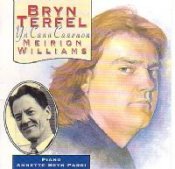
1993 brachte SAIN die CD "Un Canu Caneuon" mit Liedern des walisischen Komponisten Meirion Williams, gesungen von Bryn Terfel, am Klavier Annette Bryn Parri, heraus. Meirion Williams lebte von 1901-1976 und war einer der Verantwortlichen für die Umgestaltung des klassischen walisischen Liedes. Er legte großen Wert auf die Sprache und benutzte die Begleitung als Überhöhung der Worte und Ausdruck des Gefühls. Diese CD enthält Kompositionen von ihm aus 40 Jahren, darunter in Wales sehr bekannte Lieder, die Meirion Williams als junger Mann komponierte, und am Ende den Zyklus "Adlewych", den er als Auftragswerk für den BBC Wales als fast 70-jähriger komponierte. Stilistisch ist Meirion Williams noch ganz von der Spätromantik geprägt. Entwicklungen wie die 12-Ton-Technik sind an ihm vorübergegangen. Das schmälert aber keinesfalls die Kompositionen. Die Kompositionen sind wunderschön und leidenschaftlich und eine Entdeckung und Verbreitung außerhalb Wales' wert! Die Waliser lieben ihr Land und ihre Landschaft und davon handeln ihre Lieder in der walisischen, sehr sangbaren Sprache. Die Lieder sind in wunderschönen Melismen sehr homogen für die Sprache und menschliche Stimme geschrieben. Die Kombination Bryn Terfel / Meirion Williams ist ideal! Bryn Terfels wundervoll kernige Stimme fließt in großen Atembögen dahin, und es ist ein Genuß zuzuhören. Das Booklet ist dieses Mal sehr ausführlich in walisisch und englisch und läßt hoffen, daß möglichst viele Hörer die Lieder von Meirion Williams kennenlernen werden.

Neben den CD's von Bryn Terfel hat Sain 2004 das zweite Solo-Album des jungen walisischen Tenors Rhys Meirion herausgebracht. Rhys Meirion, der Ensemblemitglied der Frankfurter Oper war, singt in diesem Jahr Rodolfo in Sydney und Roméo in Melbourne und wird vom Label mit Bryn Terfel, mit dem er auch schon im Duett gesungen hat, verglichen. Rhys Meirion - ein sehr heller, leichter Tenor mit etwas Luft auf der Stimme - hat sich mit der Auswahl auf dieser CD keinen Gefallen getan. Schön und für seine Stimme geeignet sind die lyrischen walisischen Lieder von Dilys Elwyn Edwards, R. Lowry und Meirion Williams mit Klavierbegleitung. Auch sehr musikalisch und schön singt er "Caro Mio Ben" von Giuseppe Giordani. Leider wurde für einige Lieder und Arien Keyboard- statt Orchesterbegleitung gewählt. Der Klang des Keyboards ist so grauenvoll und irritierend, daß der Gesamtklang der Kompositionen verfälscht wird. Hinzu kommt, daß Rhys Meirion drei Kompositionen des ihm befreundeten Komponisten Robat Arwyn - mit Keyboard- und Chorbegleitung - ausgewählt hat, die musikalisch und textlich unglaublich banal sind. In den italienischen Arien "Torna a Surriento" von Curtis und "Core 'Ngrato" von Cardillo ist das Keyboard so störend, daß es schwerfällt, dem Sänger zuzuhören. Wenn man sich an Rhys Meirions hellen Klang gewöhnt hat, singt er sehr musikalisch, wobei man als Hörer erleichtert ist, wenn er die Höhe als schwer erklimmbaren Gipfel erreicht hat. Beim "Ave Maria" von Schubert - wieder mit Keyboardbegleitung - leidet der Zuhörer mit dem Sänger mit, ob wohl der Atem für die langen Bögen reicht. Das Schlußstück "Ombra Mai Fu" von Händel wurde von der Pianistin Annette Bryn Parri - aus welchem Grund auch immer - arrangiert für Keyboard, Chor und Tenor und dadurch nur banalisiert. Nach Hören dieser CD wünsche ich dem Sänger und dem Label bei der Zusammenstellung des nächsten Programms ein glücklicheres Händchen und Ohr.

Wiebke Hoogklimmer
Send to a friend

Send a link to this article to a friend with an optional message.

Friend's Email Address: (required)

Your Email Address: (required)

Message (optional):