17 May 2009
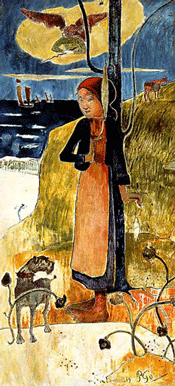
TCHAIKOVSKY: The Maid of Orléans — Moscow 1971
The Maid of Orléans: [Orleanskaya deva]: Opera in four acts
Mozart and Salieri, an opera in one act consisting of two scenes.
Nicolai Rimsky-Korsakov (1844-1908), composer. Libretto derived from Alexander Puskhin's play of the same name.
First performance: 7 December 1898 in Moscow.
Ariadne auf Naxos, Oper with a prologue and one act. Music composed by Richard Strauss. Libretto by Hugo von Hofmannsthal.
La Vestale, a tragédie lyrique in three acts.
Boris Godunov, an opera in four acts with prologue
Modest Mussorgsky, composer. Libretto by the composer, based on Alexander Pushkin's drama Boris Godunov and Nikolai Karamazin's History of the Russian Empire
First performance: 8 February 1874 at the Mariinsky Theatre, St. Petersburg
Il Trovatore, dramma in four parts.
Only a few months following the premiere of Der Rosenkavalier, Hugo von Hofmannsthal proposed a new opera to Richard Strauss based on Molière’s comedy-ballet, Le Bourgeois gentilhomme (in German, Der Bürger als Edelmann).
Die Entführung aus dem Serail, Singspiel in 3 Acts.
Music composed by Wolfgang Amadeus Mozart (1756–1791). Libretto by Johann Gottlieb Stephanie the Younger, based on an earlier libretto by
Christoph Friedrich Bretzner.
Die Entführung aus dem Serail, Singspiel in 3 Acts.
Music composed by Wolfgang Amadeus Mozart (1756–1791). Libretto by Johann Gottlieb Stephanie the Younger, based on an earlier libretto by
Christoph Friedrich Bretzner.
Arabella: Lyrische Komödie in three acts
Die Entführung aus dem Serail, Singspiel in 3 Acts.
Music composed by Wolfgang Amadeus Mozart (1756–1791). Libretto by Johann Gottlieb Stephanie the Younger, based on an earlier libretto by
Christoph Friedrich Bretzner.
La Gioconda, dramma lirico in four acts.
Music composed by Amilcare Ponchielli (1834–1886). Libretto by Arrigo Boito (under the pseudonym Tobia Gorrio), based upon Victor Hugo's Angelo, Tyrant of Padua (1835).
Don Carlo, an opera in four acts. Music composed by Giuseppe Verdi (1813–1901). Libretto by Joseph Méry and Camille Du Locle after Friedrich von Schiller’s dramatic poem Don Carlos, Infant von Spanien. Revised version in four acts (French text revised by Du Locle, Italian translation by Achille de Lauzières and Angelo Zanardini).
Un ballo in maschera, a melodramma in three acts.
Music composed by Giuseppe Verdi. Libretto by Antonio Somma, based upon the work of Eugène Scribe Gustave III ou Le bal masqué (1833)
Medea: Melodramma tragico in three acts.
Die Tote Stadt, an opera in three acts.
Music composed by Erich Wolfgang Korngold (1897-1957). Libretto by Paul Schott (Julius and E. W. Korngold) after the novel Bruges la morte by Georges Rodenbach.
Some Details concerning the Revolution inaugurated by Rossini
Manon Lescaut, dramma lirico in quattro atti
Elektra: Tragedy in one act.
Lyric Opera of Chicago has announced both schedules and cast-lists for is Spring 2020 performances of Richard Wagner’s Ring Cycle. Given the series of individual productions already staged by the company since Fall 2016, that pave the way for the complete cycle, Lyric Opera of Chicago’s complete production should affirm the artistic might of the great composer.
“Diacono himself does not know what musical talent he possesses” – Mascagni
The Maid of Orléans: [Orleanskaya deva]: Opera in four acts
Music composed by Pyotr Il’yich Tchaikovsky to his own libretto after Friedrich von Schiller’s Die Jungfrau von Orleans (1801), tragedy translated by Vasily Andreyevich Zhukovsky, Jules Barbier’s Jeanne d’Arc and Auguste Mermet’s libretto for his own opera, after Barbier (1876), with various details adapted from Henri Wallon’s biography of Joan of Arc.
First Performance: 13/25 February 1881, Mariinsky Theatre, St Petersburg
| Principal Roles: | |
| Joan of Arc | Soprano/Mezzo-Soprano |
| King Charles VII | Tenor |
| Agnès Sorel | Soprano |
| Dunois, French knight | Baritone |
| Lionel, Burgundian knight | Baritone |
| Archbishop (Cardinal in first production) | Bass |
| Raymond, Joan’s betrothed | Tenor |
| Thibaut d’Arc, Joan’s father | Bass |
| Bertrand, a peasant | Bass |
| Lauret | Bass |
| A Soldier | Bass |
| Voice from the Angelic Choir | Soprano |
Setting: France, 1431
Synopsis:
Act I
A forest near Domrémy
Thibaut, father of Joan, wants her to marry Raymond. Joan refuses, declaring that she must follow her divine destiny. Enraged, her father accuses her to be in league with the devil. News arrives that the English are devastating nearby villages. Joan inspires all to hope because Salisbury, the English commander, is destined to perish. When a soldier brings news of the death of Salisbury; all sing hanks to the Lord. Joan bids farewell to save France.
Act II
At the Castle of Chinon
The minstrels sing and gypsies dance to amuse King Charles VII and his mistress Agnès Sorel. The vassal Dunois informs the King that the royal treasure is exhausted. He urges the King to take arms. To the disdain of Dunois, Agnès offers him to contribute her own money to finance the war. The archbishop receives a report of a miracle — the French have won thanks to troops led by a young girl. Joan presents herself to the King, telling him her story. The King gives her command of the army.
Act III
Near Reims
Giovanna engages in a duel with Lionel, a Burgundian allied with the English. But when she is about to strike the deadly blow, Joan sees his face, evoking tender pity. They immediately fall in love. Lionel swears allegiance to the French cause. At the cathedral of Reims a great crowd forms to celebrate Charles’ coronation. Thibaut publicly accuses Joan of witchcraft. Dunois defends her and the archbishop questions her. Feeling guilty of her love for Lionel, Joan remains silent. Lionel implores her to run away; but she accuses him that his love has caused her downfall.
Act IV
In the forest
Lionel and Joan embrace. A choir of angels sings a warning to the girl: she has betrayed her divine mission She must therefore suffer before she receives salvation. An English contingent arrives, killing Lionel and capturing Joan.
At the old market of Rouen
The English condemn Joan to the stake for being a witch. Joan asks Dunois for a cross, which he gives her. As the fire consumes her, the celestial voices promise her a place next to God.
Click here for the complete libretto (Russian).
Click here for the complete text of Die Jungfrau von Orleans.