Recently in Books
A musical challenge to our view of the past
In Musical Exoticism (Cambridge 2011) Ralph P. Locke undertook an
extensive appraisal of the portrayal of the ‘Other’ in works dating
from 1700 to the present day, an enquiry that embraced a wide range of genres
from Baroque opera to Algerian rap, and which was at once musical, cultural,
historical, political and ethical.
Is it okay to tweet during a concert, if it allows those who couldn’t attend to engage with the performance and the music? Or is it really just distracting, on top of all the coughing?
RILM Abstracts of Music Literature is an international database for
musicological and ethnomusicological research, providing abstracts and indexing
for users all over the world. As such, RILM’s style guide (How to Write
About Music: The RILM Manual of Style) differs fairly significantly from
those of more generalized style guides such as MLA or APA.
Opera in the British Isles might seem a rather sparse subject in the period 1875 to 1918. Notoriously described as the land without music, even the revival of the native tradition of composers did not include a strong vein of opera.
Heldentenor Jay Hunter Morris tells us about the lean times when the phone did not ring, as well as those thrilling moments when companies entrusted him with the most important roles in opera.
Commonly viewed as a ‘second-rate’ composer — a European radical persecuted by the Nazis whose trans-Atlantic emigration represented a sell-out to an inferior American popular culture —
Although part of a series entitled Cambridge Introductions to Music, Robert Cannon’s wide-ranging, imaginative and thought-provoking survey of opera is certainly not a ‘beginners’ guide’.
Those of us of a certain age have fond memories of James Melton, who entertained our parents starting in the 1930s and the rest of us in the 1940s and beyond on recordings, the radio, and films.
An important new book on Italo Montemezzi sheds light on his opera Nave. The author/editor is David Chandler whose books on Alfredo Catalani have done so much to restore interest in the genre.
Assumptions about later Italian opera are dominated by Puccini, but Alfredo Catalani, born in the same town and almost at the same time, was highly regarded by their contemporaries. Two new books on Catalani could change our perceptions.
I was feeling cowed by Herr Engels. The four of us had retired from the Stravinsky performance to a Billy Wilder-themed bar in Berlin, the least horrible late-night option in the high end mediocrity of Potsdamer Platz.
This substantial book is one of the latest in the Ashgate series of
collected essays in opera studies and draws together articles from a disparate
group of scholarly journals and collected volumes, some recent, some now
difficult to locate.
Vincent Giroud’s valuable new French Opera, a Short History, is in hand and very welcome it is.
The noted operatic impresario and stage director, Lotfi Mansouri, with the professional help of writer Donald Arthur, has issued his memoirs under the title Lotfi Mansouri: An Operatic Journey.
Originally published in German as Herrin des Hügels, das Leben der Cosima Wagner (Siedler, 2007), this new book by Oliver Hilmes is an engaging portrait of one of the most important women in music during the late nineteenth and early twentieth centuries.
Robert Stuart Thomson’s Italian language learning text, Operatic Italian, promises to become an invaluable textbook for aspiring operatic singers, voice teachers, coaches and conductors.
Ralph Locke’s recent book on Musical Exoticism is both an historical survey of aspects of the exotic in Western musical culture and a discussion of paradigms of the exotic and their relevance for musicological understanding.
Readers may recognize the author of this book, David J. Buch, a specialist on the origins of the libretto to Mozart’s Magic Flute.
Perhaps it will be enough to tell you that I wasn’t halfway through this book before I searched the web for a copy of Professor Ewans’s study of Wagner and Aeschylus’s Oresteia, and ordered it forthwith: It has to be good.
Books
07 Oct 2004
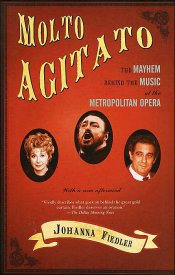
FIEDLER: Molto Agitato
I well remember my first performance at the Met. It was a not very distinguished La Bohème with Malfitano and Lima, Domingo conducting, in the winter of 1985. But at last I had made it to the Met. This was the company of Caruso, Gigli, Ponselle, Tibbett and Melchior. This was the house where Corelli and Price had given of their best. So in a sense this is my house too, because the Met is too big, too important to belong to the New Yorkers alone, witness the overwhelming majority of the subscribers to Opera News (circulation around 120,000) who are living elsewhere, a lot of them people in Europe like myself. Therefore anything concerning the Met concerns all opera lovers.
When Schuyler Chapin retired in 1975 (was ousted out is the more exact word), an area started that was very muddled for non New-Yorkers. Regularly there were announcements in Opera News that Anthony Bliss, Bruce Crawford etc. had become manager of this and that, chairman of some other things, that James Levine had this responsibility and John Dexter that one. But for us aliens, it was all very unclear while at the same time we had not the slightest idea what would be the influence of this corporate infighting on the scene of the Met. We wanted back those clear lines of command of Rudolf Bing's time. Not till Joe Volpe had his heavy hands on the reins did we once more have an understanding of who was what at the Met.
Enters Johanna Fiedler with a nice and understandable report on all and everything that happened with the corporate institution after Bing's tenure. To be fair she starts with her management-story in 1883 but leads it in 50-odd pages to the moment the waters started to muddle with Chapin's dismissal and her own (not mentioned) arrival at the press-office. In the meantime she has shown the continuity of management-problems since the start of the Met while at the same time feeding us with a few morsels of gossip (e.g. the hatred between Bing and Robinson, the womanising of Bing during the tour).
From then on she clearly and exhaustively tells us the story of the top people at the Met, the why's and the why'nots, the petty feuding, the personal infights, loves and hates (the latter more than the former). I gladly admit two things. First, I found it fascinating reading: a real look behind the sets. I also hugely enjoyed 'In House' and 'Never Mind the Moon' by Covent Garden's general-manager John Tooley and his successor Jeremy Isaacs. But in those two cases the books sometimes are an apology for a tenure in a troubled house. Fiedler did not belong to the upper echelon of the Met and therefore she has not an axe to grind (except with Domingo). She strikes me, granted an outsider 3000 miles from the precinct, as being scrupulously fair towards Bliss, Levine, Volpe and tutti quanti, stressing their strong points as well as their weaknesses. Secondly I was myself active as a television-producer and reporter for about twenty years at Flemish Public TV, an institution with a yearly budget of 200 million dollars and I recognize many of the same patterns that Fiedler so aptly describes: the bureaucratic infighting; the importance given by management to insignificant details forgetting that their reason of existence is the performance on the scene, not the number of paperclips used on a memo; the hard-headedness of management that is convinced that being a member of the Met is enough reward in itself, a decent salary is not necessary; the pettiness of the unions which want more than a fair share and are apt to kill the goose with the well-not exactly golden but anyway eatable eggs; the personal relations which can have tremendous influence on some decisions and admittedly, the lechery of some managers which can explain sometimes unexplainable features. Such stories can be somewhat dull sometimes but not with a distribution cast from strength with superhuman natures as the Met is apt to attract.
There has been quite a discussion on the book since its appearance. The press (mostly in the Times) thought it a valuable addition to the ranks (as Opera Magazine used to say of Carlo Bergonzi's début). The internet was not so enthusiastic. Too much on the top-dogs, too little dirty linen, too little morsels of really destructive gossip which have found its way since the birth of the net. But Fiedler's and the publisher's lawyers will have looked into the matter and therefore she will not have been free to write whatever she knew. Anyway, for some New Yorkers these titbits will not suffice but for the majority of us, the non-New Yorkers, there is more than enough. Fiedler has a nice way with words and succeeds very well in feeding our unhealthy but so voracious curiosity with a small sentence here, an aside over there. Open secrets they may be, but I don't know of another book mentioning the relation between Carreras and Ricciarelli or commenting on Mr.Domingo's many infidelities, maybe a small revenge of the author for Domingo's jealous hysterics towards the press department when Mirella Freni joined the Met after a long absence. The Net told us too about the many inaccuracies but they strike me as not very important: e.g. the story about Arroyo's bath-tub and the discussion on Fiedler's opinion that Susanna is the longest (correct) and most difficult (not correct) soprano-role in the repertoire.
All in all this is a must for people interested in the institutional history of this great house: a worthy successor in my opinion to Martin Mayer's '5000 Nights at the Opera' (written under the 'nom de plume' of Rudolf Bing).
Jan Neckers