Subscribe to
Opera Today

Receive articles and news via RSS feeds or email subscription.


Recently in Books

MORRIS: Reading Opera Between the Lines: Orchestral Interludes and Cultural Meaning from Wagner to Berg

Interludes in opera articulate moments when the lush voices of singers and vivid spectacle of scenery and action are removed and often the curtain is drawn, and thus they span a functional gap between textless instrumental music and explicit theatrical vehicle. Although composers and analysts suggest rich and multivalent meanings for the music, those implications often escape decoding by audiences. Even the interlude titles — Zwischenspiel, entr'acte, intermezzo — suggest their intermission-like nature. As functional placeholders for scene changes and the like, the interludes are for many a cue to relax attentive listening, read synopses, and whisper with companions. Undaunted by such complexities, Morris takes up the problematic nature of operatic interludes, engaging their ambiguities with eyes wide open in an effort to enrich our understanding of these challenging bits of music.

GOEHRING: Three modes of perception in Mozart — the philosophical, pastoral, and comic in Così fan tutte

According to the book jacket, this is the first major scholarly study of Così fan tutte, considered to be one of Mozart's least-understood operas and librettist Lorenzo Da Ponte's most interesting text. Così fan tutte has been studied extensively, despite the broad assertion stated in the book. What the author of this study brings to the reader, which others have not, is a detailed examination of the philosophical, pastoral, and comic background of the libretto, characters, and music of the opera. New perspectives on text and tone in the opera, the subtle use of the pastoral mode, and the tension and balance between philosophy and comedy are what the author brings to the study of this work. In addition, the author does an intensely close reading of the primary sources of the opera, in order to support his theories and statements.

TRIBO: Annals 1847-1897 del Gran Teatre del Liceu

The importance of the Teatre del Liceu, can not be overstated. The house ranks with all the leading theatres of the world, being right up there with Paris, London, New York, Vienna, Madrid, Rome, Milan, Lisbon, St. Petersburg, Moscow, Turin, Naples, Buenos Aires, and other cities of comparable importance. During its long history (158 years at the time of writing) it featured many of the great singers. These include Caruso, Battistini, Tamagno, Ruffo, Caballe, Tebaldi, Mario, Pavarotti, Vignas, Lazaro, O'Sullivan, Stracciari, Pagliughi, Gayarre, Masini, Stagno, Lauri-Volpi, Bellincioni, and countless others. Quite a few of these who sang there before 1897 are represented on the accompanying disc.

MAY: Decoding Wagner — An Invitation to His World of Music Drama

Thomas May's stated goal in Decoding Wagner is indeed summarized in his subtitle, An Invitation to His Music Dramas. Mr. May offers an introduction to those who may seek a reliable yet succinct guide in their first Wagnerian experience; a further potential readership is seen among those who have attended performances of Wagner but who wish to expand their appreciation of the music dramas. In his chronological overview of Wagner's oeuvre from the mid-1830s until the close of his career May presents an approachable guide to appreciating the composer's operatic genius. As an illustration of May's commentary on the works, a generous selection of Wagner's music is included on two Discs that accompany the volume in a protective sleeve.

The Cambridge Companion to the Lied

Books described as a "Companion" to this or that and published by university presses should be required to come with a Reader Beware label. As is the case with many books put out by university and many for-profit publishers, the main reason for publishing these is to advance the tenure and promotion prospects of the authors. This is not a bad thing, except that all too often the books aren't very good.

DUNSBY: Making Words Sing: Nineteenth- and Twentieth-Century Song

In Making Words Sing, Jonathan Dunsby investigates what he calls the "vocality" of song, that is, the "quality of having voice," as the author states in the introduction to his study. By using this perspective, Dunsby focuses on the intensification of the text that occurs when words are set to music, which stands in opposition to the kind of "songfulness" that Lawrence Kramer discussed in Musical Meaning: Toward a Critical History (Berkeley, CA: University of California Press, 2002).

RANDALL & DAVIS: Puccini & the Girl

"Puccini & the Girl" is a rare and engrossing work of scholarship that can be enjoyed on several levels. For the Puccini-lover, to say nothing of one who has a special interest in La Fanciulla del West, it will provide a wealth of information not previously available, particularly all in one place. Any one interested in the creative process will find it exposed and examined clearly. The scholar will recognize the fascinating chance discovery, the thrill of the chase and the deep rewards of work undertaken lovingly and with rigorous care by the dedicated and passionate co-authors.

HANSEN: The Sibyl Sanderson Story — Requiem for a Diva

Jack Winsor Hansen's 520-page biography of Sibyl Sanderson (1865 - 1903) is packed with romanticism and gossip that will delight and titillate true worshipers of operatic divas and inquisitive opera fans. It also fills a gap in the music-historical writings about opera at the end of the 19th century.

The Cambridge Companion to John Cage

Cage's music is like Einstein's theorem: most people know it exists, know it's important, but beyond these facts know nothing about it (count me in this category when it comes to Einstein).

WEAVER & PUCCINI: The Puccini Companion

If any opera lover feels daunted by the many biographies and analytical tomes dedicated to the life and art of Giacomo Puccini, Norton has done that reader a tremendous favor with the publication of The Puccini Companion. Tightly organized, this series of essays details the life, discusses the operas, and provides a wealth of supplementary information about the composer.

EVERETT: The Musical — A Research and Information Guide

Much current popular culture assumes that its audience is knowledgeable of the American musical. References to, and parodies of, specific musicals are frequently a part of episodes of The Simpsons and South Park, and ads for companies as diverse as The Gap and the World Wrestling Entertainment promotion recently have restaged numbers from West Side Story to plug their products or events. Rarely, if ever, are the sources acknowledged; it is simply taken for granted that a general audience will understand the quotations and parodies.

TOMMASINI: The New York Times Essential Library: Opera — A Critic’s Guide to the 100 Most Important Works and the Best Recordings

"I particularly want to reach newcomers" writes Anthony Tommasini, Times chief classical music critic, in his preface. I do not think they will be helped very much by this book. A rookie who picks it up and reads the subtitle may expect something more than two operas by Bellini, two by Donizetti, one Gounod (not Faust), one Massenet (not Manon) and no Lohengrin.

KRAMER: Opera and Modern Culture — Wagner and Strauss

"New musicology" is the cultural study, analysis and criticism of music, which proffers the belief that music has societal, religious, political, personal, and sexual agendas. Consequently, new musicology, much like the discussion of such topics at social gatherings, can be polarizing.

SMART: Mimomania: Music and Gesture in Nineteenth-Century Opera

Here's a serious niche book, a relatively slender volume dealing with a topic at once both arcane and surprisingly central to some of the major controversies in opera production today. I think it has major problems but it has become for me the pebble dropped into the pond that sends ripples to unexpected places, raising interesting questions in the process.

The Cambridge Companion to Grand Opera

Among the recent publications on opera, The Cambridge Companion to Grand Opera, edited by David Charlton, breaks new ground with its systematic and thorough exploration of grand opera, a specific part of the genre which played an important role in the musical culture of the nineteenth century.

LOEWENBERG: Annals of Opera, 1597-1940

This volume has long been regarded as the definitive work on the subject, and has been quoted in countless later works whenever a reference was required to the performance histories of individual operas. Taken as a whole, especially when one considers the state of library science when the book was first written, it is a magnificent piece of work, and belongs on the bookshelf of every researcher in the operatic field.

SCRUTON: DEATH-DEVOTED HEART — Sex and the Sacred in Wagner's Tristan and Isolde

Roger Scruton’s new book is an engrossing attempt, intensely argued throughout, to persuade the reader that Richard Wagner’s Tristan and Isolde is a religious work, not only in the vague sense that it elevates our feelings into an exalted condition that strikes the non-religious as “religious”, but in the precise sense that it incarnates, as the Eucharist incarnates the doctrine of Christianity, a doctrine that would give our meaningless lives a sufficient meaning if we were to believe and follow it. Nearly half a century ago, Joseph Kerman, in Opera as Drama, called Tristan “a religious drama” and suggested an analogy between it and Bach cantatas dealing with religious conversion and conveying religious experience. Twenty years later, Michael Tanner, a resolutely acute writer on Wagner, described Tristan and Bach’s St Matthew Passion as the two supreme examples of works “of which it is a prerequisite that one suspends disbelief . . . in the ethos which the work embodies and promulgates”. At the same time he admitted that the love unto death of Tristan and Isolde is not “a kind of living that can be rationally valued”. More recently and less cautiously, in his Wagner, he calls Tristan “the one work of Wagner’s which seems to be making an unconditional demand on our capacity to embrace a new, redeeming doctrine”.

MAGEE: THE TRISTAN CHORD — Wagner and Philosophy

Wagner, bloody Wagner; will we ever have done with the man? I don’t suppose that we’ll ever have done with his operas. For many of us, they are indispensable art; among the defining achievements of the Western tradition. “There is no music deeper . . . and no drama deeper either. (The Ring) is enough in itself to place Wagner alongside Shakespeare, Michelangelo and Mozart.” If you don’t think Wagner is that good, you won’t like Wagner and Philosophy, Bryan Magee’s new book about him. Whether or not he is that good, there is surely a problem that arises insistently about Wagner but not Michelangelo or Mozart or, least of all, about Shakespeare: that of getting the art clear of the artist. Shakespeare is notorious for disappearing from his plays, but Wagner is everywhere in his operas. You just can’t think about them and not think about him; nor would he conceivably have wished you to.

The Cambridge Companion to Rossini

The title of this book, "The Cambridge Companion to Rossini" probably means different things to different people.

OSBORNE: The Opera Lover's Companion

Every CD collector faces the day (or days, in the case of the truly dedicated collector) when denial no longer suffices — the shelves are sagging and overflowing, and the time has come to purchase yet another storage unit. Perhaps others have done what I did once to forestall that day — I removed all the booklets from my opera sets (and cover boxes as well, of course) and stored them on that increasingly archaic furniture item, a bookshelf.

OPERA TODAY ARCHIVES »

Books

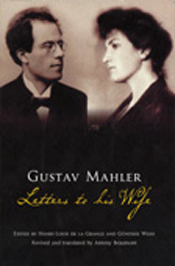
Gustav Mahler.  Letters to His Wife
23 Jan 2007

Gustav Mahler. Letters to His Wife

True to the title of this collection, the present volume of correspondence edited by Henry-Louis de La Grange and Günther Weiss — here translated, revised , and supplemented by Antony Beaumont — offers, to date, the most complete body of letters of Gustav Mahler to his wife Alma.

Gustav Mahler. Letters to His Wife

Ed. Henry-Louis de La Grange and Günther Weiss, in collaboration with Knud Martner. Trans. and revised Antony Beaumont. (Ithaca, NY: Cornell University Press, 2004)

ISBN: 0-8014-4340-7

$32.00  Click to buy

Whether additional correspondence will in the future surface, the model presented here by the editors, and in the present revised translation, should prove to be a critical yardstick which would surely accommodate subsequent additions.

Although previous collections of the Mahlers’ letters have been issued in numerous preliminary and corrected editions, Beaumont lays forth convincing evidence for his translation as well as emendations to the 1995 German edition. For his revised English version of the German original, both accessibility and accuracy have been guiding principles. In the Foreword and — just as pointedly — the “Preface to the English Edition” Beaumont makes clear from comparative charts and commentary that a significant amount of correspondence appears here in English for the first time. Further, since the appearance in 1995 of the German edition of the letters, both the release of material from the Moldenhauer archives and the publication of Alma Mahler’s early diaries (Tagebuch-Suiten) have yielded a more complete picture of the decade or so of nearly regular correspondence.

The organization of the present edition and translation differs from previous attempts to catalogue and make accessible the letters and related material. As an example, in the edition of Alma Mahler, Gustav Mahler: Memories and Letters (3rd revised ed. and trans., D. Mitchell, B. Creighton, K. Martner) the diary-entries and letters were presented in two separate parts of the volume. Beaumont’s edition, by contrast, attempts to integrate both aspects by interspersing the letters with excerpts from the diaries or recollections, and by inserting regular editorial commentary or elaboration as an aid to the reader. At the same time, surviving entries on postcards and telegrams directed by Gustav to Alma Mahler are included chronologically as equivalent testimony with the letters. Finally, because of the transfer of significant material from the Moldenhauer archives to the Bavarian State Library, individual dates for letters have been verified or corrected on the basis of new, available evidence.

Since the translation of letters which appeared in both the new and previous editions differs — for the most part — in style, we may concentrate on that which the present edition offers as supplementary data. Beaumont has devised a key to indicate, among other matters, 1) letters or communications that have not previously been published, and 2) portions of letters with passages marked that had formerly been “suppressed.” These passages are identified with parenthetical marking (<…>) and function, at times, as the introduction to substantial letters. The reader thus now has the opportunity to perceive some letters in their entirety and to consider subsequent paragraphs differently because of the potential for restored information at the opening. In other examples, internal passages in the letters, constituting groups of sentences or short phrases, have been restored, these also being marked with the key indicating previous suppression. It would be further helpful for scholarly purposes to have an exact specification of the source(s) for each of the restored passages; this could be supplied via a traditional apparatus. That having been said, scholars must now ask if the newly available parts of these letters yield a different or modified picture — or perhaps new interpretive insights — into the creative personalities of Gustav or Alma Mahler, if not both.

Many of the letters from Gustav to Alma were written during the period of their courtship or during extended times of professional separation after their marriage. These latter periods were inevitably occasioned by Mahler’s duties as conductor, during periods of isolation for composition, or as part of a related professional invitation. As a consequence, Mahler’s voice in this correspondence is divided between lover, husband, composer, conductor, mentor, and reporter of travel anecdotes. Several groups of the letters, taken from representative period of the correspondence, will provide a sense of the topics discussed along with the range of comments dealing with artistic and personal issues.

As a first such group, Gustav Mahler’s letters written to Alma during December 1901 — several months before their marriage — will show some of the modifications offered in the present edition. At the time Mahler had traveled to Berlin for a performance of his Fourth Symphony. A letter written to Alma on 14 December had — in previous critical editions — given rise to some concern on exact dating, since Mahler had inscribed the letter “15 December.” Beaumont’s edition confirms the dating of 14 December, proposed earlier by Mitchell and Creighton. In a subsequent letter from this Berlin sojourn [16 December 1901], Gustav Mahler’s explanation of his “flippant tone” in a previous missive to Alma has now been restored in Beaumont’s edition. This letter shows the effect of including, at both the start of the letter and within the body of the text, several substantial passages that had been stricken from the text as it appeared in previous editions. Again, the supposition of a correction to the dating is here affirmed [Mahler had written incorrectly 17 December 1901]; further, the lengthy first paragraph and a later, similar insert establish continuity and demonstrate a typical surge from personal to aesthetic before returning to the topic of a planned rendezvous, all within the text of one letter. Gustav Mahler’s attempt in the restored first paragraph to account for his flippancy was occasioned by Alma’s epistolary references to another man. Mahler explains in this newly available paragraph that she simply did not understand his tone — as related in print — and that she would have appreciated his jovial attempts to “educate” her, had they been physically together. He concludes this paragraph by glossing over a previous disgruntled attitude and referring to a future bliss in common. In the second paragraph, which had appeared in print previously, Mahler refers to his work and public opinion on the same; he cautions Alma not to respond to other, uninformed views — especially those of his detractors in Vienna, who surely did not understand his art. When read after the first, restored paragraph, the tone of the mentor continues logically between topics — personal and professional, emotional and aesthetic — so that the second paragraph does not bear as unmotivated a tone. Likewise, a later, restored paragraph in this letter elaborates on their planned reunion once Mahler had returned to Vienna. Alma had apparently suggested that he visit her immediately upon arrival; in the newly edited version, Mahler pleads “administrative duties” that would distract him from emotional concentration, if he did not settle these first before visiting Alma. Without this paragraph the earlier version of the letter depicts Mahler as an urgent suitor who relies on his beloved to prepare her family for their relationship on the basis of his falsely presumed accessibility.

During a similar series of communications in September and October 1903 Gustav Mahler commented to Alma on leading artistic figures in Vienna as well as his visit to Amsterdam to conduct the Concertgebouw Orchestra in performances of his Third Symphony. In a previously unpublished letter to Alma, inscribed “Vienna, 4 September 1903,” Mahler declares that he has “absolutely nothing to report.” After complaining of headaches and personal anxiety, he goes on to speak of decisive figures at the Hofoper: Alfred Roller and Anna von Mildenburg are discussed along with a visiting tenor who must be accommodated. Since this letter is now, for the first time, available, scholars have further evidence of the hectic parade of notables regularly accompanying Mahler’s duties at the opera. In the following month Mahler traveled via Frankfurt to Amsterdam. On a postcard depicting Goethe and his parents — now published in Beaumont’s edition — Mahler writes of a similar journey with Alma during the previous year and his wish to travel with her again. The following letters from Amsterdam compliment Willem Mengelberg’s kindness and the astounding preparedness of the Concertgebouw Orchestra which Mahler was rehearsing for performances of his Third. Although Mahler appreciated Mengelberg’s domestic hospitality, he suggests to Alma that they lodge at a hotel, should they visit Amsterdam as a couple in the future. Aside from objecting to restrictions on his freedom, Mahler seems to have revised his opinion — as witnessed in passages here restored — on a possible relocaton to Holland after eventual retirement. Finally, in a brief yet significant aside (previously deleted), Mahler confides to Alma in the letter of 20 October 1903 that the Concertgebouw Orchestra was intent on performing all of his symphonies up to that time. Although the comment is not equivalent to evidence of a contract, the inspiration of hope is clear. Such newly added details show that Mahler’s reputation and appreciation of his creativity was gaining in international circles, despite his complaints to Alma — less than two years before — of being misunderstood in his chosen home environment of Vienna. Surely these additions make the revised version of the letters from Gustav to Alma Mahler a significant source for further scholarship on the composer, his creativity, and the productive relationship between two individuals which helped shape the course of modern music.

Salvatore Calomino
Madison, Wisconsin
Send to a friend

Send a link to this article to a friend with an optional message.

Friend's Email Address: (required)

Your Email Address: (required)

Message (optional):