Recently in Books
A musical challenge to our view of the past
In Musical Exoticism (Cambridge 2011) Ralph P. Locke undertook an
extensive appraisal of the portrayal of the ‘Other’ in works dating
from 1700 to the present day, an enquiry that embraced a wide range of genres
from Baroque opera to Algerian rap, and which was at once musical, cultural,
historical, political and ethical.
Is it okay to tweet during a concert, if it allows those who couldn’t attend to engage with the performance and the music? Or is it really just distracting, on top of all the coughing?
RILM Abstracts of Music Literature is an international database for
musicological and ethnomusicological research, providing abstracts and indexing
for users all over the world. As such, RILM’s style guide (How to Write
About Music: The RILM Manual of Style) differs fairly significantly from
those of more generalized style guides such as MLA or APA.
Opera in the British Isles might seem a rather sparse subject in the period 1875 to 1918. Notoriously described as the land without music, even the revival of the native tradition of composers did not include a strong vein of opera.
Heldentenor Jay Hunter Morris tells us about the lean times when the phone did not ring, as well as those thrilling moments when companies entrusted him with the most important roles in opera.
Commonly viewed as a ‘second-rate’ composer — a European radical persecuted by the Nazis whose trans-Atlantic emigration represented a sell-out to an inferior American popular culture —
Although part of a series entitled Cambridge Introductions to Music, Robert Cannon’s wide-ranging, imaginative and thought-provoking survey of opera is certainly not a ‘beginners’ guide’.
Those of us of a certain age have fond memories of James Melton, who entertained our parents starting in the 1930s and the rest of us in the 1940s and beyond on recordings, the radio, and films.
An important new book on Italo Montemezzi sheds light on his opera Nave. The author/editor is David Chandler whose books on Alfredo Catalani have done so much to restore interest in the genre.
Assumptions about later Italian opera are dominated by Puccini, but Alfredo Catalani, born in the same town and almost at the same time, was highly regarded by their contemporaries. Two new books on Catalani could change our perceptions.
I was feeling cowed by Herr Engels. The four of us had retired from the Stravinsky performance to a Billy Wilder-themed bar in Berlin, the least horrible late-night option in the high end mediocrity of Potsdamer Platz.
This substantial book is one of the latest in the Ashgate series of
collected essays in opera studies and draws together articles from a disparate
group of scholarly journals and collected volumes, some recent, some now
difficult to locate.
Vincent Giroud’s valuable new French Opera, a Short History, is in hand and very welcome it is.
The noted operatic impresario and stage director, Lotfi Mansouri, with the professional help of writer Donald Arthur, has issued his memoirs under the title Lotfi Mansouri: An Operatic Journey.
Originally published in German as Herrin des Hügels, das Leben der Cosima Wagner (Siedler, 2007), this new book by Oliver Hilmes is an engaging portrait of one of the most important women in music during the late nineteenth and early twentieth centuries.
Robert Stuart Thomson’s Italian language learning text, Operatic Italian, promises to become an invaluable textbook for aspiring operatic singers, voice teachers, coaches and conductors.
Ralph Locke’s recent book on Musical Exoticism is both an historical survey of aspects of the exotic in Western musical culture and a discussion of paradigms of the exotic and their relevance for musicological understanding.
Readers may recognize the author of this book, David J. Buch, a specialist on the origins of the libretto to Mozart’s Magic Flute.
Perhaps it will be enough to tell you that I wasn’t halfway through this book before I searched the web for a copy of Professor Ewans’s study of Wagner and Aeschylus’s Oresteia, and ordered it forthwith: It has to be good.
Books
29 May 2007
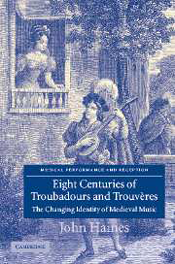
Eight Centuries of Troubadours and Trouvères: The Changing Identity of Medieval Music
The interpretive reception of medieval music begins, as John Haines lays forth in the present investigation, already during the latter period of the Middle Ages.
Although the term
“chansonnier” came into use only during the eighteenth century, the collections thus signified of
troubadour and trouvère songs — assembled between the mid-thirteenth and early fourteenth
centuries — were a significant interpretive source of earlier musical invention. Before analyzing
the first such collections, Haines sketches a brief history characterizing the individual poets of
each group and their contributions during the twelfth and thirteenth centuries. While allowing
for a progressive development from the southern poet or troubadour to a northern counterpart in
the figure of the trouvère, Haines maintains a clear distinction going beyond a mere influence or
exclusive imitation. The southern experimentation in the art de trobar is shown to become, in its
contrast among the subsequent tradition of the trouvères, simpler in form and stylistically “more
playful.” [12] Further differences are noted in the background of the poets, just as Haines marks
gradual distinctions among successive generations of the northern trouvères. After an initial
identification with the nobility, the later groups of trouvères originate, as here shown, in clerical
or non-noble circles. As an additional point in the thesis presented, it is argued that the
preservation of songs from the troubadours and trouvères was due, in part, to changes in the
sociological and cultural landscape of the poet and audience. By the late thirteenth century
Haines posits a “waning” of the song-art in composition at the same time that the collection of
earlier songs was first undergoing commission. The copying of songs, often now paired with
musical notation, removed such texts from the exclusive domain of performance and created a
new context for their continued albeit altered appreciation. Featured here among the reasons for
these earliest “editions” of the medieval lyric in France was the growth of an urban culture in
areas such as Toulouse and Arras. With steady increase and diversification during the twelfth
and thirteenth centuries these newly expanded metropolitan areas produced both poets and an
appetite for collective volumes within a greatly enhanced industry of book production. The “first
readers” of chansonniers proved themselves to be avid collectors, such that the earliest surviving
volumes exhibit already a noteworthy diversity. Some of these first codices contain a mix of
both troubadour and trouvères melodies, while others show a more restrictive use of available
sources. In order that present readers might appreciate the contents of the early chansonniers,
Haines provides informative charts mapping out their chronology, current location of
manuscripts, and available data on lost sources which presumably included musical notation.
In his second chapter with an emphasis on late medieval and early modern reception of medieval
song-texts, Haines outlines reasons why the period from 1400 to 1700 was crucial for
establishing a subsequent historical image of the Middle Ages. A primary focus is here given to
the sixteenth-century scholars Jean de Nostredame and Claude Fauchet, both of whom published
fundamental historical investigations defining and categorizing — for their time — the legacy
of the troubadours and trouvères. Although these works count among the first scholarly
investigations on medieval song, Haines argues that they also gave rise to the earliest legendary
stories about the poets, which persisted well into the eighteenth century and beyond.
Nationalism, as symbolized in the quasi-historical depictions of Roland and Amadis,
complements the critical and popular reaction to the poets as related by Haines, especially for the
period of the Renaissance. As summarized by Haines, the reception of these two figures in
legend “came out of a Franco-Italian debate over medieval literatures which itself was linked to
the emergence of nationalism in both countries during this period.” [59] As a result of such
debate, the legacy of the two groups of poets was determined, according to this argument, by the
latter part of the seventeenth century. A literary competition of sorts between the two Romance
nations prompted the selection of northern poets, or trouvères, as representative of the spirit of
France. The neglect of the troubadours — as well as a sustained rivalry between the two groups
of medieval poets — essentially had its roots in this significant period of reception.
In his following chapters on the reaction to medieval song during the eighteenth and nineteenth
centuries Haines emphasizes dominant trends exemplified by figures such as Dr. Charles Burney,
Pierre Aubry, and Gaston Paris. As expected from the response of contemporary European
cultures including German and Dutch, a renewed interest in Old French literature by
eighteenth-century “enlightened readers” signified not only a rediscovery of earlier poetic
traditions but also a search for authentic literary evidence in the form of manuscripts. The earlier
groundwork of Fauchet and Nostrdedame proved to be invaluable, if now subject to revision and
expansion in the multi-volume literary histories undertaken during the time of Dr. Burney. As
verified by Haines’s admirable survey of contemporary sources and commentary, the study of
medieval French literature was a “legitimate scholarly concern” by the latter half of the
eighteenth century. [93] Because of an earlier, and still at the time persistent, emphasis on songs
of the trouvères, one is justified in asking after the fate of texts and music by the troubadours.
After the publication of the first troubadour melody by Dr. Burney in his General History of
Music (1782), the path was opened for a broader and more inclusive examination of earlier forms
by poets from various geographic regions. The subsequent nineteenth-century reception of songs
by the trouvères and troubadours represents, for Haines, a continuation of interest and study,
which was present and “maintained from the Middle Ages on.” [157] His chapter on varying
approaches to the medieval lyric throughout the nineteenth century succeeds in elaborating on
such methods as a further development in the line of reception rather than a fresh discovery of
medieval texts, as has been previously argued.
Whereas a number of musicological studies during the past decade or so have dealt with the
survival of chant during the post-medieval period, the present monograph offers a revision of
earlier views on music associated with the troubadours and trouvères. In addition to correcting a
number of inaccurate or stereotypical assumptions, Haines presents the continuous reception of
medieval song as a field to be studied both for its own merits and as a measure of cultural
preference. The volume concludes with an extensive and useful bibliography.
Salvatore Calomino
Madison, Wisconsin