16 Aug 2007
Madame Butterfly: The Search Continues
Over the past decade, there have been a plethora of works trying to identify the historical models for characters in Puccini’s famous opera Madama Butterfly.
A musical challenge to our view of the past
In Musical Exoticism (Cambridge 2011) Ralph P. Locke undertook an extensive appraisal of the portrayal of the ‘Other’ in works dating from 1700 to the present day, an enquiry that embraced a wide range of genres from Baroque opera to Algerian rap, and which was at once musical, cultural, historical, political and ethical.
Is it okay to tweet during a concert, if it allows those who couldn’t attend to engage with the performance and the music? Or is it really just distracting, on top of all the coughing?
RILM Abstracts of Music Literature is an international database for musicological and ethnomusicological research, providing abstracts and indexing for users all over the world. As such, RILM’s style guide (How to Write About Music: The RILM Manual of Style) differs fairly significantly from those of more generalized style guides such as MLA or APA.
Opera in the British Isles might seem a rather sparse subject in the period 1875 to 1918. Notoriously described as the land without music, even the revival of the native tradition of composers did not include a strong vein of opera.
Heldentenor Jay Hunter Morris tells us about the lean times when the phone did not ring, as well as those thrilling moments when companies entrusted him with the most important roles in opera.
Commonly viewed as a ‘second-rate’ composer — a European radical persecuted by the Nazis whose trans-Atlantic emigration represented a sell-out to an inferior American popular culture —
Although part of a series entitled Cambridge Introductions to Music, Robert Cannon’s wide-ranging, imaginative and thought-provoking survey of opera is certainly not a ‘beginners’ guide’.
Those of us of a certain age have fond memories of James Melton, who entertained our parents starting in the 1930s and the rest of us in the 1940s and beyond on recordings, the radio, and films.
An important new book on Italo Montemezzi sheds light on his opera Nave. The author/editor is David Chandler whose books on Alfredo Catalani have done so much to restore interest in the genre.
Assumptions about later Italian opera are dominated by Puccini, but Alfredo Catalani, born in the same town and almost at the same time, was highly regarded by their contemporaries. Two new books on Catalani could change our perceptions.
I was feeling cowed by Herr Engels. The four of us had retired from the Stravinsky performance to a Billy Wilder-themed bar in Berlin, the least horrible late-night option in the high end mediocrity of Potsdamer Platz.
This substantial book is one of the latest in the Ashgate series of collected essays in opera studies and draws together articles from a disparate group of scholarly journals and collected volumes, some recent, some now difficult to locate.
Vincent Giroud’s valuable new French Opera, a Short History, is in hand and very welcome it is.
The noted operatic impresario and stage director, Lotfi Mansouri, with the professional help of writer Donald Arthur, has issued his memoirs under the title Lotfi Mansouri: An Operatic Journey.
Originally published in German as Herrin des Hügels, das Leben der Cosima Wagner (Siedler, 2007), this new book by Oliver Hilmes is an engaging portrait of one of the most important women in music during the late nineteenth and early twentieth centuries.
Robert Stuart Thomson’s Italian language learning text, Operatic Italian, promises to become an invaluable textbook for aspiring operatic singers, voice teachers, coaches and conductors.
Ralph Locke’s recent book on Musical Exoticism is both an historical survey of aspects of the exotic in Western musical culture and a discussion of paradigms of the exotic and their relevance for musicological understanding.
Readers may recognize the author of this book, David J. Buch, a specialist on the origins of the libretto to Mozart’s Magic Flute.
Perhaps it will be enough to tell you that I wasn’t halfway through this book before I searched the web for a copy of Professor Ewans’s study of Wagner and Aeschylus’s Oresteia, and ordered it forthwith: It has to be good.
Over the past decade, there have been a plethora of works trying to identify the historical models for characters in Puccini’s famous opera Madama Butterfly.
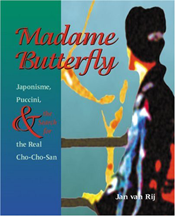
Jan van Rij’s Madame Butterfly: Japonisme, Puccini, and the Search for the Real Cho-Cho-San is the latest — but by no means the last — in a series of passionate educated guesses attempting to track down the “real” Madame Butterfly. The problem has been trying to read the minds and interpret the words of a number of people involved in the creative process leading up to the first performances of the opera in Italy in 1904. Of particular interest to historical sleuths are comments made by John Luther Long, the Philadelphia lawyer and writer, in the preface to his 1903 version of Madame Butterfly (the story that inspired the opera), and those of Jennie Correll, his sister and source for the original 1897 Butterfly account, in a talk to the Tokyo Pan Pacific Club and a subsequent magazine article in 1931. The remarks by both Long and Correll are extremely vague and subsequently have led to a wide variety of interpretations. In Long’s response concerning the models for Cho-Cho-San, Pinkerton, and even the original story, he states the following: “And is she a fancy, or does she live? Both. And where is Pinkerton? At least not in the United States navy - if the savage letters I receive from his fellows are true. Concerning the genesis of the story I know nothing.”[1] Jennie Correll, who lived in Nagasaki with her Methodist missionary husband from 1892 to 1897, stated in her September 1931 magazine article that the model for Cho-Cho-San was a certain Nagasaki tea-house girl named Cho-San. The young girl, along with her baby, had been abandoned by her lover, who had promised to return by ship but never did.[2]
While these vaguely-worded assertions may have inspired van Rij and others to search for historical models of characters in both the book Madame Butterfly and the opera Madama Butterfly, the investigative trail has, indeed, been a foggy one. Van Rij begins what his publicity release refers to as his “operatic detective story” by examining the role that two relationships between European men and Japanese women from Nagasaki might have had on the book and the opera.
The German physician Philip Franz von Siebold worked for the Dutch trading post at Dejima from 1823 to 1830 before being expelled from the country. During his stay in Nagasaki, Siebold lived with a Japanese woman named Otaki-san and their daughter Oine-san. Siebold returned to Nagasaki in 1859 after the foreign settlement in the city opened and met briefly with his Japanese “wife” and daughter.[3] Van Rij refers to Siebold’s story as ”a prototype of sorts as it contained many of the ingredients of the later novel and play that would be the precursors to Puccini’s opera” (p. 24).
While the links between Siebold and Otaki-san to the Butterfly accounts are, to this writer, tenuous at best, the second relationship mentioned by van Rij - that of Pierre Loti and his young Japanese “wife” Okiku-san - clearly did have a strong influence on both Long and Puccini. Pierre Loti (the pen name of the French naval lieutenant Julien Viaud) stayed in Nagasaki during the summer of 1885 and two years later published an account of his adventures in the city entitled Madame Chrysantheme.[4] I agree with van Rij that “the Butterfly theme...entered Western literature for the first time through Loti’s book” (p. 33) and that ”much of the material of Long’s novel comes straight from Loti” (p. 112). Indeed, the contention that Madame Butterfly was based on Loti’s account has been argued by historians for years.[5]
Van Rij next examines the impact of Japonisme on the development of Puccini’s opera. The curiosity involving “things Japanese” for Europeans and Americans in the last half of the nineteenth century is undeniable and this fascination led to a boom in Western artistic works concerning the customs and lifestyles of these exotic people from the Orient. Van Rij investigates a number of possible influences of Japonisme on Puccini or his librettists — especially Camille Saint-Saens’s La Princesse Jaune, Pietro Mascagni’s Iris, Judith Gautier’s La Marchande de Sourires, Sidney Jones’s The Geisha, Gilbert and Sullivan’s The Mikado, and Andre Messager’s Madame Chrysantheme. He also notes the possible inspiration of a Japanese touring group and Claude Debussy. Van Rij concludes this chapter of his book somewhat uncertain of specific influences, but absolutely convinced that Japonisme in some form played a key role in the opera’s creative evolution. “Whatever Puccini’s sources were, it is clear that Madama Butterfly was a product of Japonisme” (p. 56).
Chapter Three concerns the development of John Luther Long’s book* Madame Butterfly and the subsequent play developed from the novel by David Belasco. Van Rij investigates what Long did with the tale of “Cho-San,” as told to him by his sister Jennie Correll from her days in Nagasaki, and how he fused this story with Loti’s Madame Chrysantheme to create his best-selling account. Van Rij concludes that “Obviously, nearly all of the elements of Long’s story have been borrowed from Loti” (p. 66). Long is given credit for little more than “chang[ing] some of the persons he borrowed from Loti into new characters and...introduc[ing] a plot” (p. 67). One important change concerned the character Cho-Cho-San and for this he relied heavily on his sister’s account. Van Rij also asserts that Long added a moral message to his account that was lacking in the more diary-based descriptive work of Loti (p. 74).
Long’s novel soon came to the attention of the American playwright David Belasco. Belasco developed the book into a one-act play that debuted in New York in March 1900. Belasco changed the characters little but added two major components to the plot: a more dramatic vigil by Cho-Cho-San and her ultimate suicide. In June, Belasco took the play to London, where it was viewed with great delight by Puccini, who was in the city to supervise production of Tosca and to search for new ideas for his next opera.
In Chapter Four, van Rij discusses the making of the opera Madama Butterfly by Puccini and his librettists. He especially concentrates on material borrowed from the novels of Loti and Long and the play of Belasco. He concludes the chapter with an analysis of the failure of the opera’s disastrous premiere at Milan and the changes made before its successful second performance three months later at Brescia.
Chapter Five, in which van Rij speculates as to the real-life models for the characters in Madama Butterfly and Madame Butterfly, is the most controversial section of the book. Here he argues, not altogether convincingly according to this reviewer, that: Cho-Cho-San was modeled after a Nagasaki woman named Kaga Maki; her son, Trouble, was modeled after Kuraba Tomisaburo, a boy of mixed Scottish-Japanese parentage; and the father of Tomisaburo was more than likely not Thomas Glover, the famous merchant who (with his Japanese wife, Tsuru) raised the boy as his own, but Glover’s brother, Alfred.
At this point, van Rij enters a contentious debate to which he alludes in passing, but does not do justice to in all its convolutions. The main players in this recent international debate concerning models for characters in the Butterfly book and opera are Brian Burke-Gaffney, a Canadian scholar and translator who lives and works in Nagasaki; Noda Kazuko, a descendent of Tsuru Glover’s presently living in Tokyo, Arthur Groos, a professor of German Studies at Cornell University in the United States, and van Rij, a former lawyer and diplomat now residing in France.[6]
In 1991, Groos argued that, based upon Jennie Correll’s talks of 1931 and subsequent research on his part, the model for Pinkerton was most likely an American naval officer named William B. Franklin, who was in Nagasaki in 1892 aboard the U.S.S. Marion.[7] Groos also speculated as to possible models for other characters in the opera, but as for Cho-Cho-San he states that “we know almost nothing about the original Butterfly” [8] and “we may in fact never know any more about the historical O-Cho than what Jennie Correll tells us. To be sure, the real madame Butterfly remains mute.”[9]
In the meantime, Noda set out to prove that her great- great-grandmother,Tsuru Glover, was the model for Cho-Cho-San. Her efforts grew out of a crusade to rebut the claims by Burke-Gaffney in 1989 that, according to family records, Kaga Maki, not Tsuru, was the mother of Kuraba Tomisaburo.[10] Noda has gone around the world pressing her claim that Tsuru was not only the mother of Tomisaburo, but that she was - as Noda’s father had speculated in a 1972 book - the model for Cho-Cho-San as well.[11] The latter assertion is based on a collection of circumstantial evidence, including the fact that Tsuru wore a butterfly crest on her kimono.
Last spring, Burke-Gaffney countered with his book on Butterfly, claiming that the search for historical models beyond the general ones found in Loti is useless because the Glover-Butterfly connection was fabricated by Americans in Nagasaki during the occupation of the city after World War Two. To prove his point, he claims - among other things - that prior to the war there was no mention of this connection in either local guidebooks or local histories. He demonstrates how the wife of an American Occupation official living in the Glover house deliberately began the rumor and how Nagasaki officials later picked up on the story to publicize the large tourist attraction at Glover Garden in the former foreign settlement.[12]
Van Rij has now added to this controversy with his book. He discounts Groos’s assertion about the Pinkerton model, by saying that Groos relied too much on the historical authenticity of Long’s book and Jennie orrell’s 1931 accounts (pp. 112-115 and note #1, pp. 175-177). Instead, van Rij argues that “B.F. Pinkerton...is obviously modeled on Pierre Loti” (p. 69).
Van Rij rejects Noda Kazuko’s and Noda Heinosuke’s view that Tsuru Gloveris Tomisaburo’s mother and accepts Burke-Gaffney’s claim that Kaga Maki is, indeed, the mother (pp. 120-121 and note #8, p.178). He then goes even further by naming her as the Butterfly model — a rather unconvincing claim made earlier by a biographer of Thomas Glover.[13] His identification of Alfred Glover as the most likely candidate for Tomisaburo’s father (p. 134) is his own contribution as far as I can tell.
I remain unconvinced by van Rij’s claims regarding historical models for characters, because I do not believe that they exist for any of the main characters in Madame Butterfly or Madama Butterfly. More convincing is van Rij’s contention that the accounts by Long and Correll should not be viewed as repositories of historical truths. I would also question the historical importance of some of van Rij’s third-party sources: especially the one attributed to Miura Tamaki (the Japanese soprano famous for her role as the operatic Butterfly) told to her by Long that Tomisaburo was Butterfly’s son by an English merchant (p. 118 and note #7, pp. 177-178), and a second story Tomisaburo supposedly told another person in 1931 or 1932 that was passed on years later by a third party to Noda Heinosuke. Since van Rij rejects other aspects of the Noda accounts as unreliable, it seems surprising that he would place his historical faith in this story. Finally, van Rij’s claim that Alfred Glover was Tomisaburo’s father is pure speculation and frankly it is unlikely to receive much support from scholars in the field.
Van Rij’s final chapter briefly discusses the fact the Madama Butterfly has never been well-received by Japanese audiences. And the reasons for this should not be difficult to understand. The heroine, Cho-Cho-San, is hardly depicted in a complimentary manner and the opera is filled with historical and linguistic inaccuracies. As van Rij rightfully notes, ”The only attraction of the Japanese element of the story is the flattering fact of a foreign novel with a plot set in Japan and turned into a popular opera by a famous European composer(p. 140).
This has not, however, kept generations of Westerners - including van Rij - from falling in love with the opera. Madama Butterfly remains one of the most often performed operas in the world and undoubtedly speculation will continue to abound as to the historical models behind its main characters. Rather than accept the vagaries of undetermined influences from figures such as Pierre Loti, Jennie Correll and John Luther Long (and, as van Rij has shown, the genre of Japonisme) the search for the ”real” Cho-Cho-San will go on - and on and on!
Notes
1. John Luther Long, Madame Butterfly (New York: Grosset and Dunlap, 1903), p. xiii.
2. Mrs. Irvin H. Correl [sic], “Madame Butterfly: Her Long Secret Revealed,” The Japan Magazine, 21 (1931), pp. 341-345, as found in Van Rij, p. 60 and Groos, p. 130.
3. During the almost thirty year interval, Siebold married a European woman with whom he had five children.
4. Pierre Loti, Madame Chrysantheme (Paris: Calmann-Levy, 1887).
5. For example, see Jean-Pierre Lehmann, The Image of Japan (London: George Allen and Unwin, 1978), p. 91. Lehmann also argues that “O-Kiku san became Cho Cho san, from Madame Chrysantheme to Madame Butterfly” (p. 92), but van Rij would say that it is more complicated than that.
6. In addition to van Rij’s book under review here, the most representative works of the other three are: Arthur Groos, “Madame Butterfly: The Story,” in Cambridge Opera Journal, Vol. 3, No. 2 (July 1991), p. 125-158; Noda Kazuko, Madame Butterfly and Madame Tsuru Glover (Tokyo: DISCO Networking, 1998); and Brian Burke-Gaffney, Cho cho fujin o sagashite [Searching for Madame Butterfly] (Tokyo: Kurieitsu Kamogawa, 2000).
7. Groos, pp. 141-148.
8. Ibid., p. 156.
9. Ibid., p. 158.
10. Burke-Gaffney, Hana to shimo [Blossoms and Frost] (Nagasaki: Nagasaki Bunkensha, 1989), p.98.
11. Noda Heinosuke, Guraba fujin [Mrs. Glover] (Nagasaki: Shinnami Shobo, 1994 [orig. 1972]), pp. 51-58.
12. Burke-Gaffney, Cho cho fujin o sagashite, especially pp. 54-70.
13. The claim was made by Alexander McKay in his book Scottish Samurai: T.B. Glover, 1838-1911 (Edinburgh: Canongate Press, 1993).
Reviewed by Lane Earns (earns@uwosh.edu), Department of History, University of Wisconsin Oshkosh. This review first appeared in H-Net and is copyright 2001 by H-Net, all rights reserved. It is reprinted with the permission of the author.
* [OT: As a point of clarification, “Madame Butterfly” first appeared in the form of a novella in the January 1898 issue of The Century Illustrated Monthly Magazine. In 1903, Grosset and Dunlap issued “Madame Butterfly” in novel form merely by “stretching out the story by printing only a small square of text on each page and by adding illustrations.” Brian Burke-Gaffney, Starcrossed — A Biography of Madame Butterfly (Norwalk: Signature Books, 2004), 76.]
Addendum. Since Rij’s book appeared, two other studies have been published: (1) Brian Burke-Gaffney, Starcrossed — A Biography of Madame Butterfly (Norwalk: Signature Books, 2004) and (2) Jonathan Wisenthal et al., A Vision of the Orient — Texts, Intertexts, and Contexts of Madame Butterfly (Toronto: University of Toronto Press, 2006).