Recently in Books
A musical challenge to our view of the past
In Musical Exoticism (Cambridge 2011) Ralph P. Locke undertook an
extensive appraisal of the portrayal of the ‘Other’ in works dating
from 1700 to the present day, an enquiry that embraced a wide range of genres
from Baroque opera to Algerian rap, and which was at once musical, cultural,
historical, political and ethical.
Is it okay to tweet during a concert, if it allows those who couldn’t attend to engage with the performance and the music? Or is it really just distracting, on top of all the coughing?
RILM Abstracts of Music Literature is an international database for
musicological and ethnomusicological research, providing abstracts and indexing
for users all over the world. As such, RILM’s style guide (How to Write
About Music: The RILM Manual of Style) differs fairly significantly from
those of more generalized style guides such as MLA or APA.
Opera in the British Isles might seem a rather sparse subject in the period 1875 to 1918. Notoriously described as the land without music, even the revival of the native tradition of composers did not include a strong vein of opera.
Heldentenor Jay Hunter Morris tells us about the lean times when the phone did not ring, as well as those thrilling moments when companies entrusted him with the most important roles in opera.
Commonly viewed as a ‘second-rate’ composer — a European radical persecuted by the Nazis whose trans-Atlantic emigration represented a sell-out to an inferior American popular culture —
Although part of a series entitled Cambridge Introductions to Music, Robert Cannon’s wide-ranging, imaginative and thought-provoking survey of opera is certainly not a ‘beginners’ guide’.
Those of us of a certain age have fond memories of James Melton, who entertained our parents starting in the 1930s and the rest of us in the 1940s and beyond on recordings, the radio, and films.
An important new book on Italo Montemezzi sheds light on his opera Nave. The author/editor is David Chandler whose books on Alfredo Catalani have done so much to restore interest in the genre.
Assumptions about later Italian opera are dominated by Puccini, but Alfredo Catalani, born in the same town and almost at the same time, was highly regarded by their contemporaries. Two new books on Catalani could change our perceptions.
I was feeling cowed by Herr Engels. The four of us had retired from the Stravinsky performance to a Billy Wilder-themed bar in Berlin, the least horrible late-night option in the high end mediocrity of Potsdamer Platz.
This substantial book is one of the latest in the Ashgate series of
collected essays in opera studies and draws together articles from a disparate
group of scholarly journals and collected volumes, some recent, some now
difficult to locate.
Vincent Giroud’s valuable new French Opera, a Short History, is in hand and very welcome it is.
The noted operatic impresario and stage director, Lotfi Mansouri, with the professional help of writer Donald Arthur, has issued his memoirs under the title Lotfi Mansouri: An Operatic Journey.
Originally published in German as Herrin des Hügels, das Leben der Cosima Wagner (Siedler, 2007), this new book by Oliver Hilmes is an engaging portrait of one of the most important women in music during the late nineteenth and early twentieth centuries.
Robert Stuart Thomson’s Italian language learning text, Operatic Italian, promises to become an invaluable textbook for aspiring operatic singers, voice teachers, coaches and conductors.
Ralph Locke’s recent book on Musical Exoticism is both an historical survey of aspects of the exotic in Western musical culture and a discussion of paradigms of the exotic and their relevance for musicological understanding.
Readers may recognize the author of this book, David J. Buch, a specialist on the origins of the libretto to Mozart’s Magic Flute.
Perhaps it will be enough to tell you that I wasn’t halfway through this book before I searched the web for a copy of Professor Ewans’s study of Wagner and Aeschylus’s Oresteia, and ordered it forthwith: It has to be good.
Books
04 Oct 2007
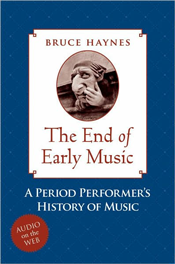
HAYNES: The End of Early Music — A Period Performer’s History of Music for the Twenty-First Century
Once upon a time, there was something known as early music. This was not so much a repertoire, a musico-historical epoch, as an attitude, a counter-cultural group.
There was classical music, the boring old
standard-repertoire taught at conservatories, and played in the same old way
by people who fetishized the lineage of their teachers, and their teacher’s
teachers, and then there was early music, the music of Bach and his
predecessors, played by amateur performers (often musicologists) on “old”
instruments (recorder, harpsichords, viola da gamba), something which fit
right in with the reclaiming of folk music and folk instruments by the hippie
resistance to manufactured mass culture.
At the same time Albert Ayler and John Coltrane were exploring the outer
limits of free jazz, and Jefferson Airplane combining psychedelics and
folk-rock, amateur ensembles with krummhorns, sackbuts, shawms, and other
dead instruments were reviving centuries of forgotten repertoire from Machaut
onwards. Early music managed to be cutting edge by going deep into music
which had been only of interest to historians, and transgressive by
suggesting that this music and the music which followed did not belong only
to its self-anointed priesthood, which seemed to be only mumbling
half-understood inherited formulas, with no sense of the enlivening spirit
within.
Time passes, and nothing from 1967 seems very current anymore, with the
possible exception of Purple Haze. The amateur (and hippie) tinge to
early music was washed away by decades of musicians who managed to perform
early music professionally on period instruments, and with an historical
awareness of the performance issues involved. Their success drew the barbed
words of musicologist Richard Taruskin, himself once an amateur
performing-musicologist, pointing out the lack of authenticity
involved in this recuperation of both unknown and well-known repertoire.
The End of Early Music may be seen as a response to the criticisms
of Taruskin and others.
Oboist Bruce Haynes is one who has been involved with
historically-informed performance for decades, since the first successes of
four or five decades ago, and unlike the younger Taruskin, whose recordings
are safely entombed on LP in music libraries, his recordings are still
commercially available. His survey of the history and issues involved with
period performance is compulsively readable. Though the volume has the
standard scholarly apparatus of notes and bibliography, there is nothing of
the dry-as-dust scholarly compendium about it. An innovation which is
particularly useful is the provision of sound examples at the publisher’s
site, even if means that the book can be best used with your network-enabled
computer close at hand.
The notion that concert-going has become a secular ritual substituting for
more explicitly religious rites has become widely accepted, but Haynes goes
farther in looking at the amount of fetishism and ritual involved in musical
interpretation and consumption in general, disassembling the various fetishes
we take for granted as part of musical experiences – the notion of the
canon, of absolute music, of genius, of score-fidelity, and others. Evidently
I sympathize with Haynes’ position, but even so I think it must be clear to
any reader that he has done his work well.
Tom Moore
[This review has been cross-posted to Biddle Beat, The official blog of
the Music Library at Duke University.]