28 Jul 2008
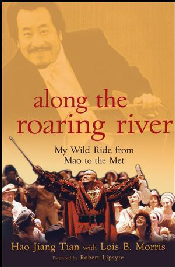
Along the Roaring River
Chinese bass Hao Jiang Tian was 30, when he enrolled as an undergraduate at the University of Denver 1983.
A musical challenge to our view of the past
In Musical Exoticism (Cambridge 2011) Ralph P. Locke undertook an extensive appraisal of the portrayal of the ‘Other’ in works dating from 1700 to the present day, an enquiry that embraced a wide range of genres from Baroque opera to Algerian rap, and which was at once musical, cultural, historical, political and ethical.
Is it okay to tweet during a concert, if it allows those who couldn’t attend to engage with the performance and the music? Or is it really just distracting, on top of all the coughing?
RILM Abstracts of Music Literature is an international database for musicological and ethnomusicological research, providing abstracts and indexing for users all over the world. As such, RILM’s style guide (How to Write About Music: The RILM Manual of Style) differs fairly significantly from those of more generalized style guides such as MLA or APA.
Opera in the British Isles might seem a rather sparse subject in the period 1875 to 1918. Notoriously described as the land without music, even the revival of the native tradition of composers did not include a strong vein of opera.
Heldentenor Jay Hunter Morris tells us about the lean times when the phone did not ring, as well as those thrilling moments when companies entrusted him with the most important roles in opera.
Commonly viewed as a ‘second-rate’ composer — a European radical persecuted by the Nazis whose trans-Atlantic emigration represented a sell-out to an inferior American popular culture —
Although part of a series entitled Cambridge Introductions to Music, Robert Cannon’s wide-ranging, imaginative and thought-provoking survey of opera is certainly not a ‘beginners’ guide’.
Those of us of a certain age have fond memories of James Melton, who entertained our parents starting in the 1930s and the rest of us in the 1940s and beyond on recordings, the radio, and films.
An important new book on Italo Montemezzi sheds light on his opera Nave. The author/editor is David Chandler whose books on Alfredo Catalani have done so much to restore interest in the genre.
Assumptions about later Italian opera are dominated by Puccini, but Alfredo Catalani, born in the same town and almost at the same time, was highly regarded by their contemporaries. Two new books on Catalani could change our perceptions.
I was feeling cowed by Herr Engels. The four of us had retired from the Stravinsky performance to a Billy Wilder-themed bar in Berlin, the least horrible late-night option in the high end mediocrity of Potsdamer Platz.
This substantial book is one of the latest in the Ashgate series of collected essays in opera studies and draws together articles from a disparate group of scholarly journals and collected volumes, some recent, some now difficult to locate.
Vincent Giroud’s valuable new French Opera, a Short History, is in hand and very welcome it is.
The noted operatic impresario and stage director, Lotfi Mansouri, with the professional help of writer Donald Arthur, has issued his memoirs under the title Lotfi Mansouri: An Operatic Journey.
Originally published in German as Herrin des Hügels, das Leben der Cosima Wagner (Siedler, 2007), this new book by Oliver Hilmes is an engaging portrait of one of the most important women in music during the late nineteenth and early twentieth centuries.
Robert Stuart Thomson’s Italian language learning text, Operatic Italian, promises to become an invaluable textbook for aspiring operatic singers, voice teachers, coaches and conductors.
Ralph Locke’s recent book on Musical Exoticism is both an historical survey of aspects of the exotic in Western musical culture and a discussion of paradigms of the exotic and their relevance for musicological understanding.
Readers may recognize the author of this book, David J. Buch, a specialist on the origins of the libretto to Mozart’s Magic Flute.
Perhaps it will be enough to tell you that I wasn’t halfway through this book before I searched the web for a copy of Professor Ewans’s study of Wagner and Aeschylus’s Oresteia, and ordered it forthwith: It has to be good.
Chinese bass Hao Jiang Tian was 30, when he enrolled as an undergraduate at the University of Denver 1983.
That was late in life to set out on the career that has nonetheless taken him from Mao to the Met — and beyond, but that’s only one feature that makes Along the Roaring River, the singer’s account of his life, a fascinating book.
During his first American decade Tian sang a variety of supporting roles with Denver’s Opera Colorado. In 1988 he attracted a larger audience in an Aspen Wild-West staging of Verdi’s Falstaff that — prophetically — featured an almost all-Asian cast. He made his Met debut opposite Luciano Pavarotti in Verdi’s Lombardi 1993.
He was — among his many “firsts” — the first Chinese to sing Verdi in Italy and to appear in Beethoven’s Fidelio in Germany. (The problems that he encountered at the hands of make-up crews account for lighter moments in his story.) It has also been a career that took took Tian home to China and then made him a major figure in introducing new Chinese opera to this country. In 2006 he sang the premiere of Tan Dun’s First Emperor at the Met and two years later he was on stage in Central City as the Poet Li Bai in Guo Wenjing‘s account of the eighth-century author.
In Along the Roaring River: My Wild Ride from Mao to the Met, Tian, born in Beijing in 1954, tells of more than his life in opera, and that makes the book, written with the able aid of Lois B. Morris, a document of its time. Tian labels his Chinese roots “revolutionary military,” for his parents had been underground Communists back in the days when Chiang Kai-shek led the Chinese against the Japanese invasion that was a major chapter of World War Two. But his early life of privilege — better food, better clothing, better housing — did not last. With Mao’s Cultural Revolution of the 60’s, even this background was no insurance against suspicion. His parents were exiled from Beijing, and Tian went to work in the city’s boiler works, today a Chinese-American joint venture. Nonetheless he learned guitar and accordion and slowly built a second career in music while banging out boilers. Yet he had loathed early piano lessons and recalls the pleasure that he took in smashing the family’s records of Western music that were anathema to the ears of the “new” China. Thus the book is also a sorrowful report on a tragic chapter of history that witnessed, for example, the death of millions of Chinese through the mismanagement of Mao and his lieutenants.
These horrors are offset by the love story that is a further dimension of this report: Tian’s happy — and fortuitous — marriage to London-born Martha Liao, who left a major career in genetics to serve as producer, manager, gourmet cook and all around genius in helping the singer achieve the fame that he now enjoys. High on the list of Liao’s successes is the founding of Asian Performing Arts of Colorado, the organization that made Poet Li Bai possible.
In the most poignant moment in the book Tian recalls a day when Met rehearsals for Emperor were going badly. Everyone was tired and tensions were running high. At the piano Tian began playing songs from the Cultural Revolution. The Chinese colleagues from that era joined in, and the defeatist mood was broken. “Strange to say, for some of us there was magic under Chairman Mao,” Tian writes. “The creative fire was lit and fed in an environment that was inhospitable to anything but the party line. We had nothing. There was nothing to have. What was there was ours, a simple song in the mountains, a couple of stuffed dumplings, a glass of beer, a line of poetry, a back and forth about literature…. “How bizarre that I was rediscovering it all again among my Chinese Cultural Revolution peers in this bastion of high Western culture in twenty-first century America.”
New Yorker music critic Alex Ross provides a significant supplement to Tian’s book in his article “Symphony of Millions,” an account of musical life in China today, in the July 7 issue of that magazine. He tells of visiting Tian and Martha at their Beijing home and offers insights into Poet LiBai with — alas — no mention of the role of the Central City Opera in staging the work.
On September 13 Hao Jiang Tian sings Chang the Coffin Maker in the world premiere of Stewart Wallace’s Bonesetter’s Daughter at the San Francisco Opera. Amy Tan has written the libretto after her novel of the same title.
Wes Blomster