Recently in Recordings
24 Sep 2006
In her debut recording the young Roumanian soprano Katarina Jovanic demonstrates her talent in performing an intriguing selection of Lieder by Schubert, Brahms, and Strauss. »
24 Sep 2006
Myto does many an opera-lover a service by offering this enjoyable recording of Rossini's French grand opera, here called Moïse. »
24 Sep 2006
For a period of close to half a century, French grand opera, as exemplified by the works of Giacomo Meyerbeer and his school, was the preferred form of music for the theatre (i.e. opera) in most of the civilized world. »
22 Sep 2006
It is somewhat ironic that until recent years Italy has generally been slow to take a leading role in the historical performance movement: ironic in that historically Italy both dominates and defines the early baroque style and ironic in that that style enshrines the primacy of text— the Italian text. »
20 Sep 2006
The first thing I noticed in the liner notes was the bold print claiming Cimarosa was born in 1797 and died in 1848, which correspond exactly with Donizetti’s lifespan. »
12 Sep 2006
Robert Ashley has the uncanny ability to sprinkle diamonds amidst great swaths of apparently trivial and quotidian detritus–diamonds that trigger the nervous system in an intensely stimulating fashion. »
12 Sep 2006
The later Günter Wand was a remarkable interpreter of Bruckner’s music, as is demonstrated in this live recording from the Schleswig-Holstein Music Festival. »
09 Sep 2006
Sony Records occasionally still sends the odd CD to reviewers hoping they will give it notice. »
08 Sep 2006
Callas fans better skip this review, as they won’t like the tone, the words, or whatever slights real or imagined they may perceive. »
08 Sep 2006
At the expense of stating a truism, the music of Gustav Mahler, like that of other composers, is best experienced live in the concert hall. »
08 Sep 2006
This Fanciulla is such a wonderful issue because, for once, none of the three protagonists ever recorded their role commercially, so that one is spared the many doublings often met in live recordings. »
07 Sep 2006
During the last few years Antoni Wit has recorded Mahler’s symphonies one by one, such that he is building a fine cycle for the Naxos label. »
31 Aug 2006
The program for this recent recording from the choir of Westminster Cathedral presents sacred choral works by Brahms and Rheinberger, anchored at one end by Brahms’s youthful Missa Canonica and at the other by Rheinberger’s Mass for Double Choir in E-flat, Op. 109. with a handful of motets by Brahms in between. »
29 Aug 2006
This cast looks quite promising on paper. However, I cannot honestly say these big names keep their promise, except for the comprimario-singers. »
29 Aug 2006
I can readily understand why Bayreuth refuses to perform Richard Wagner’s third opera. »
29 Aug 2006
Verdi responded to the death of Rossini in 1868 by planning a collaborative Requiem Mass, drawing on the contributions of thirteen “distinguished” composers. »
28 Aug 2006
Francis Poulenc is well known for the religious works that comprise much of his oeuvre after he was traumatized by the accidental and premature death of his friend Pierre-Octave Ferroud in 1936. »
28 Aug 2006
The music of John Dunstable embodies many of the characteristics that so dramatically set the music of the emerging Renaissance apart from its Medieval forebears. »
28 Aug 2006
Sometimes an invidious comparison cannot be avoided, and such is the case with two recent DVD versions of Georg Frederic Handel's masterpiece, Giulio Cesare. »
25 Aug 2006
The English “Oxbridge” choral tradition tends to be a cohesive one, most often with choirs of men and boys receiving similar training, singing a largely shared repertory in similar venues and in similar contexts. »
25 Aug 2006
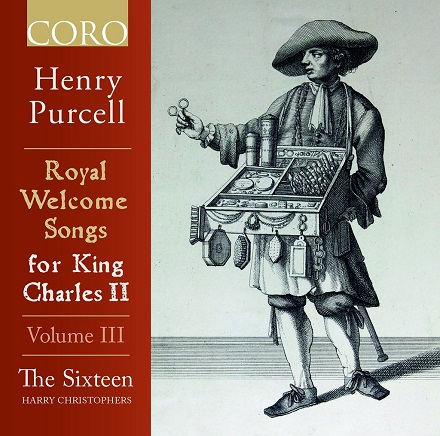
Harry Christophers and The Sixteen have a particular affinity for pre-modern polyphony, as their long discography, teeming with the music of the Eton Choirbook, assorted Renaissance masters, Handel, Bach, and others, amply shows. »
25 Aug 2006
Some argue that Bayreuth ushered in the modern era of regietheatre in opera productions with its now-legendary centennial Der Ring des Nibelungen, directed by Patrice Chereau. »
25 Aug 2006
In Turkey recently, we visited a second-grade classroom, where our guide invited the children to sing songs for us. »
25 Aug 2006
It seems only natural that the quality of radiance should quickly come to mind in contemplating the twelfth-century Basilica of Saint Denis, where luminous stained glass creates colored walls of mystical light. »
25 Aug 2006
Pentatone Classics joins some smaller recording companies staking out niche markets as the biggest labels continue their enforced retreat from the classical marketplace. »
25 Aug 2006
In recent European reviews, Teatro Regio di Parma’s DVD of their 2004 Verdi Gala was generally labeled as worthless. »
25 Aug 2006
Tower Records online DVD page shows eleven available incarnations of Verdi's classic La Traviata, four of which have appeared in the last year, including one filmed at the reopening of La Fenice in Venice, and a Zurich production reviewed recently for Opera Today by yours truly. »
25 Aug 2006
This installment of the estimable Bach Cantata Pilgrimage recordings brings together cantatas from the middle of the Epiphany season, along with a “refugee” from Trinity XXIV), and the well-known motet, “Jesu, meine Freude.” »
25 Aug 2006
This is a most sympathetic performance, though perhaps being a Fleming helps. In my small country on the frontier of Northern and Southern European influences, many musical styles made their entrance and became popular. »
25 Aug 2006
Internationally acclaimed soprano, Solveig Kringelborn, now has recorded a delightful selection of late nineteenth-century German Lieder on the NMA label. »
25 Aug 2006
In making words sing, to use a phrase from a recent study of the poetics of vocal composition, Aribert Reimann (b. 1936) does not emulate another composer as much as he makes fashions his own lines and punctuates them with accompaniments that serve as a means of accentuating the text. »
25 Aug 2006
We can easily imagine the pleasure that Bach must have taken in presiding over a household that was both large and talented enough to form its own complete ensemble. »
25 Aug 2006
Had Plato been a 19th century opera fan, would the philosopher have been so sure that there exists an ideal version of each and every opera, in the way that all chairs come from one immutable concept of "chair"? »
13 Aug 2006
Myto is always generous with its timings, usually producing very full CD’s and thus of necessity offering a bonus if a performance doesn’t fill the whole of the record. »
13 Aug 2006
Most of us who listen to opera often chose a work to relax us on a quiet evening; perhaps lighting some candles, and opening that bottle of good vino you’ve been saving for a special occasion. »
10 Aug 2006
When the Ring theater burned in Vienna, on December 8, 1881,1 Richard Wagner commented that it left him “cold” to know that a number of patrons should die while at a performance of Jacques Offenbach’s music. »
03 Aug 2006
The Waldbühne in Berlin is a large copy of ancient Greek theatres. Originally it was the ‘Reichssportfeld’, built for the Olympic Games of 1936. »
02 Aug 2006
In summer doldrums? Spend a delightful hour with two great artists in a rare joint appearance, as Fabula Classics has resurrected for DVD a 1985 Cesare Siepi and Mirelle Freni televised recital. »
02 Aug 2006
Commemorating some of its outstanding concerts of the 1980s and Bernard Haitink, its principal conductor (from 1967-1979), the London Philharmonic Orchestra has released on its own label a single CD that includes several
pieces that brought notice to the ensemble. »
02 Aug 2006
Recorded in early May 2005 at Crear, an artists’ community in Argyll, Scotland, this CD contains selections of Lieder and songs that fit well the supple voice of the mezzo-soprano Ann Murray, who is accompanied facilely by the Scottish pianist Malcolm Martineau. »
01 Aug 2006
Connoisseurs of pretentious booklet essay verbiage will delight in the prose style of Matthias Kellerin his musings for this EuroArts DVD of Ennio Morricone conducting his film scores with the Munich radio orchestra. »
27 Jul 2006
Dietrich Buxtehude’s Membra Jesu nostri is a large-scale Passion work dedicated to the Swedish chapelmaster, Gustav Dübin, in whose notable collection, now at Uppsala, it holds a prominent place. »
27 Jul 2006
Was it so many years ago that lovers of Wagner's titanic multi-part opus, Der Ring Des Nibelung, focused their passion principally on audio versions? »
24 Jul 2006
“These probably unique documents may well owe their existence to the presence of Joan Sutherland in the cast and represent the earliest recordings of the great diva. »
24 Jul 2006
Naxos reinforces its status as the classical recording world's bargain leader by releasing a single CD highlights disc from its complete Don Giovanni, recorded in 2000 and originally released in 2001. »
24 Jul 2006
This new Naxos recording offers a rare opportunity to hear three little-known works by one of the 20th century's greatest composers - The Execution of Stepan Razin op. 119, October op. 131, and Five Fragments for orchestra op. 42, by Dmitri Shostakovich (1906-75). »
24 Jul 2006
Is this the application of Peter’s Principle on Ruperto Chapi’s music as Chris Webber, editor of www.zarzuela.net preaches, or is this proof of Chapi being “undoubtedly the most important Spanish
composer of stage music of all time” as the sleeve notes tell us? »
24 Jul 2006
Its foundational interest in affective response made the early Baroque era a time rich in the nurture of highly impassioned music and text. Little surprise then that laments, with their characteristic emotional intensity, were particularly at home on the early seventeenth-century stage and in the chambers of the nobility. »
24 Jul 2006
Whatever its flaws - and it has them - this Zurich Opera production of Debussy's Pelléas and Mélisande boasts qualities that carry it very far from the standard view of those opera goers who considers the work dry, dull, and depressingly long. »
24 Jul 2006
Recorded approximately 35 years ago in September 1971, Bernard Haitink’s performance of Gustav Mahler’s Eighth Symphony remains a classic account of the composer’s demanding score. »